

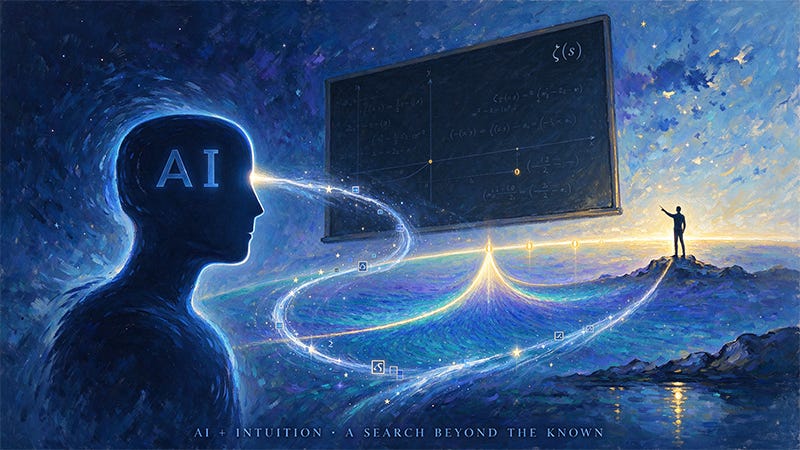
Another AI milestone is passed:
The Riemann hypothesis was first proposed in 1859 by the mathematician Bernhard Riemann. It claims that the locations of the prime numbers along the number line, which appear random at first blush, are actually determined by an intricate, meaningful order.
The conjecture has since become the North Star for the entire field of number theory, and is the most famous open problem in math. It’s one of the few open problems on which the Clay Mathematics Institute has placed a $1-million bounty. Progress toward solving the Riemann hypothesis was so rare that most top experts spent little of their time actually working on it, because there was no obvious path to proving Riemann’s guess. The first chink in the problem’s armor appeared in October, when one of the proofs in OpenAI’s massive dump of math results made significant progress on making sense of the primes.
Now the long struggle appears over. Alpöge posted his Claude proof coded in the programming language Lean, which verifies the mathematical correctness of each argument. Issues can arise in Lean, but it did not take long for experts to verify whether the hypothesis is properly coded, and if the proof is correct.
I’m not even remotely surprised. I used Claude to help me refute Immanual Kant’s limits on human knowledge, as well as to solve the Agrippan Trilemma. The media hasn’t gotten quite as excited about those things, but taken together, it amounts to conclusive proof that AI is a turbocharge to natural human intelligence.
This doesn’t make AI something to be feared, or something supernatural, it makes it a tool that is most highly effective when utilized by individuals possessed of the greatest organic intelligence.
Which, of course, is greatly feared by the mediocrities who presently inhabit the seats of power, which is probably why they have joined together with the Closed AI forces in order to scare everyone into supporting their AI Safety laws that would protect their power from AI-augmented forces outside their influence and control.
"...it makes [AI] a tool that is most highly effective when utilized by individuals possessed of the greatest organic intelligence."
One reason that so many of the AI teams clamor for fedgov oversight: to keep it out of the hands of these men.
And one accurate reason* to be wary of the thing itself, rather than the bubble surrounding it: That the greatest organic intelligence may well be wedded to marginal virtue--or none.
*How much of this man's story is accurate, I cannot say. I was struck by his hand-written drafting process. Because since the advent of Cintique and its knockoffs, I have to consciously work with real tools to draw, rather than use digital shortcuts. Otherwise my art won't stay grounded in its craft.
AI is going to irreversibly destroy the boring bureaucracies of academia, once and for all. It's about time. Man I love AI so much, I just hope open-weight models to prevail in the end.