
John Carter has written a long, and thoughtful article about the way in which the current state of the universities strongly resembles the historical situation of the European monasteries just prior to their mass dissolution across the West, and how AI has ended the pretense that a university education is a sufficient proxy for intelligence and employability. He then closes with this idea about how the still-useful aspects of the universities could be repurposed in a societally useful manner.

Artificial Intelligence promises to rot our brains in the same way that automobiles and labour-saving appliances rotted our bodies. It will be the easiest thing in the world to let the AI do all of our thinking for us, and because we are by default a lazy species, most of us will do just that. This will very rapidly turn the brains of much of the population into overboiled instant ramen, capable of little more than doomscrolling and writing the occasional prompt. Grok, is this true?
The only possible way to keep our minds stay nimble and sharp is to deliberately engage in challenging intellectual pastimes, without the aid of machines ... or, at least, without using the machines in the wrong way: barbells and exercise bikes are also machines, but they are machines specifically designed to strengthen the body. Doing this requires self-discipline. You can’t force anyone to study, just as you can’t force anyone to work out. Since it requires self-discipline, and since the cognitive differences between the deep-fried masses and the self-selected amateur philosophers will be as immediately apparent as the difference in physique between the gym rat and the couch potato, study will become a high-status activity. But it will not be a high-status activity in the sense that it is mandatory to find a high-status job. It won’t be the credential that matters. It will be high-status because the activity itself is high status. ‘Going to school’ will be high-status because that is a thing high-status people do, just as they also go to the gym.
At intellectual fitness schools organized on this model, preventing cheating will of course be every bit as impossible as it is under the current model. But if you cheat, you miss the point, as you won’t get the cognitive benefits of deep study and contemplation. It would be like riding a motorcycle instead of a bicycle: you’ll get there faster but to no benefit to your cardiovascular endurance. Cheating won’t be so much of an issue because the majority of students will be those who choose to attend for the sake of the material they wish to learn, for the sake of the experience of learning itself. Others of course will attend just to be seen attending – high-status leisure activities always attract the status-hungry who care more for the status than the activity. Whatever: they’ll be a source of revenue, and might actually learn something along the way.
‘Graduation’ and the awarding of ‘degrees’ will probably be phased out entirely as both obsolete and beside the point. Rather than paying through the nose for a few years of drunken partying in a hermetically sealed theme park with a cheap piece of paper at the end as memento and participation trophy, such schools will simply offer monthly memberships, for as long or as short a period as students wish to renew them. It will be more like a private club in which topics of interest are debated, intellectual competition is encouraged, and experimentation is facilitated. Think a makerspace with a salon attached.
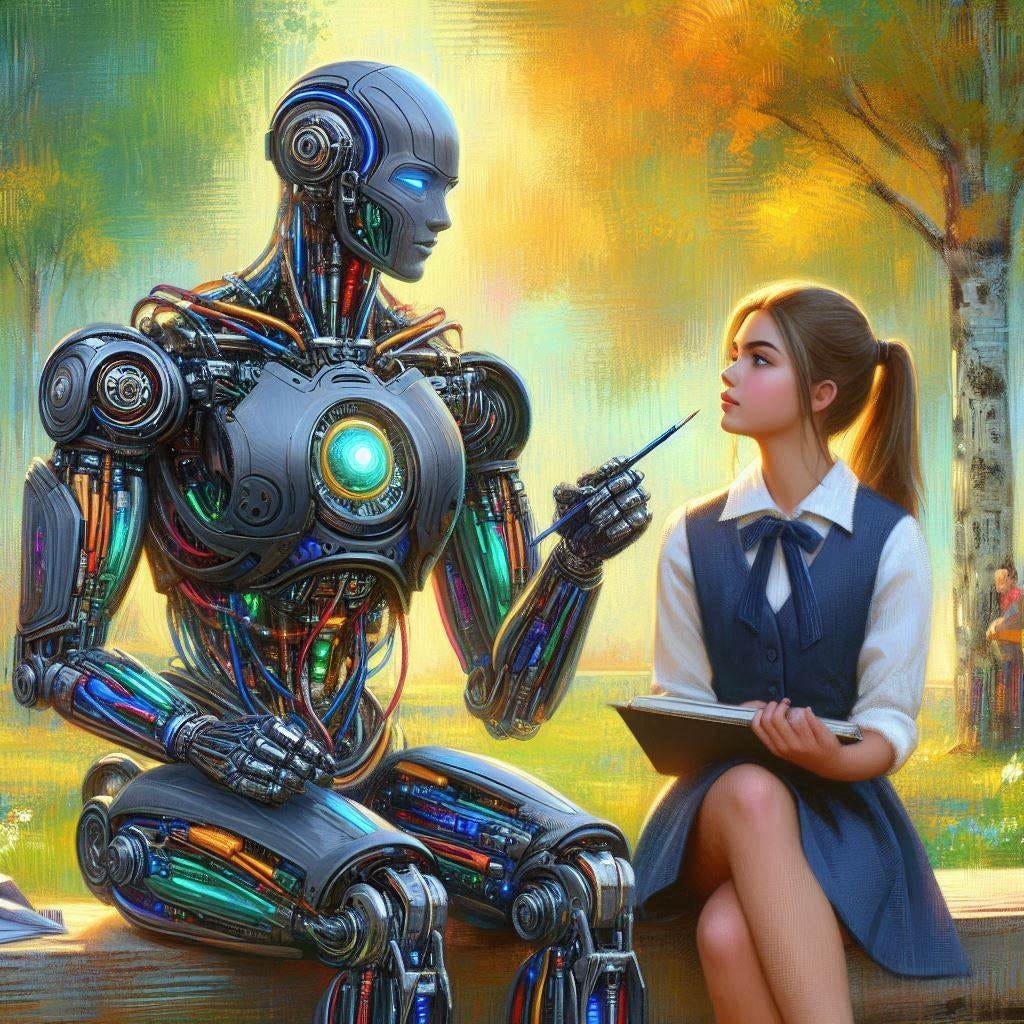
There is almost no point here in ‘courses’ as we usually think of them, or in ‘grading’, because personalized AI tutors can perform all of these functions. An LLM is essentially a talking library that has read every encyclopedia, novel, monograph, philosophical tract, poem, holy book, essay, scientific journal article, legal document, and op-ed piece ever written in any language back to beginning of recorded history, and which is happy to discuss that vast body of accumulated human knowledge at whichever level of sophistication the user is capable of, drawing whatever connections within it the user is interested in, in whichever language, idiom, and style the user finds most congenial, and doing so with inexhaustible patience. There are already elementary schools, such as the private Alpha School chain in Texas, using AI to provide children with personalized instruction. The results are apparently excellent: students are able to learn the entire Common Core curriculum in two hours a day (and yes I know Common Core is terrible, but that is not the point), with the rest of their time available for whatever projects and activities their adult supervisors – referred to as ‘guides’ rather than ‘teachers’ – can come up with. The students are learning more quickly and efficiently, with more time for play, with the result that learning itself becomes a form of play rather than a hateful chore. Every kid – and every adult – is about to have the Young Lady’s Illustrated Primer from The Diamond Age.
Schools as places of instructing and evaluation have become obsolete. Even something like Alpha is a transitional form: there’s no particular reason that AI tutors must be used during school hours, and therefore no reason that school hours can’t be devoted entirely to open, free-form, creative exploration in which students apply the knowledge and skills they’ve learned on their own time as they pursue whatever projects they please together with their friends.

The entire concept of school is being reinvented, and AI is only going to speed up and facilitate that process. The outmoded Prussian pedagogical model that has been dominant for the last 200 years is clearly inefficient, suboptimal, and totally incapable of providing the results expected by parents and required by society.
This is just another area where AI may well destroy an entire industry, and in doing so, significantly improve the human condition.
The sooner it destroys credentialism, the better. Too many people lean on those pieces of paper without having really any individual thinking or genuine intellectual curiosity. It’s remarkable I once dreamed of being a college lecturer, but the more I got involved, the more I realised how stultifying the whole system was, and converged of course, and so I got as far away as I could. This AI will break some things, some of those things need to be replaced though, for the good of society.
AI for learning is probably in the top 3 usecases for AI. Sure is number 1 for me. Right now most every intellectual activity has an absurd amount of learning overhead required that is getting bigger and bigger by the second. People don't want to go through it, they just want in on the action. AI will give them just that. After that learning becomes a lot easier.
I started a new job last month that required me to learn an absurd amount of image processing, that would have normally taken me a month to do and would have included reading a number of very boring technical books, the ones that usually take 3 or 4 chapters to get to the point, when you've already forgotten where you started. It took me about 2 days using AI to start doing my job. Frankly, if not for AI I'd probably have been fired.