

Using AI to edit novels is something that’s coming up quite a bit in the media, mainly because of authors making mistakes and leaving their prompts in their final texts, as people blast the use of AI. For the purposes of editing, AI can be very useful, but one also has to check its accuracy as a human on top of its work, or it can hallucinate on various topics, including typos.
Typo hunting is the bane of any author’s existence. It seems every manuscript will have some typos in it, no matter how many eyeballs look for them, and no matter how professional those eyeballs are at editing. Moreover, hunting for said typos is a tedious endeavor, requiring hours of slowly staring at pages an author has already written, usually done at a stage when a writer gets burnt out and wants to move on to the next project.
AI can be a useful tool in typo hunting, but there are limitations. I used both Claude Sonnet 4.0 and Grok to go through a recent manuscript for typos, and there are some things to pay attention to in both programs before simply trusting the AI that it will remove all typos.
The first step is to input a small chunk of the document. I recommend keeping it under 2,000 words so the AI has better odds at being consistent and accurate. If you upload an entire novel, for example, the AI will not be able to find anything useful as it’s too much data to extract.
Another thing to note is that it should identify typos and allow the human author to replace them manually. You don’t want AI rewriting anything directly because it might hallucinate and change some of your manuscript. If you’re okay with this and want to, then read the end result to see what it changed, it’s a gamble for how much it will do. AI is not the best for grammatical errors—and—really—loves—overusing—and-misusing—emdashes, as one example.
Asking Claude Sonnet to find typos was an interesting task. I input a chapter as per the screenshot, and it came back with this:
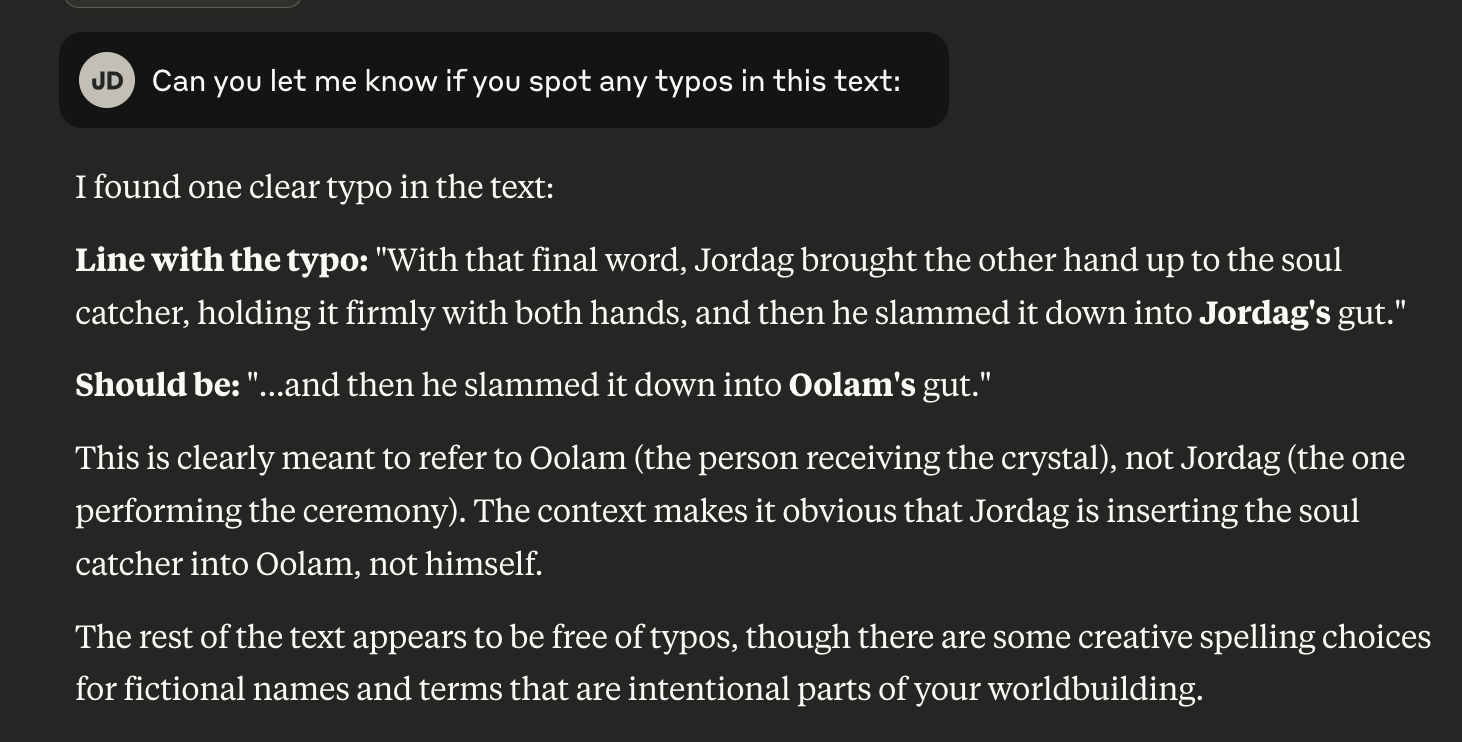
While it’s great and a correct change, it was also wrong, not because of anything in the prompt here, but it was a lie of omission. There were more typos in the chapter. I asked it to run a couple of more chapters, and noticed each time it told me it found exactly one typo.
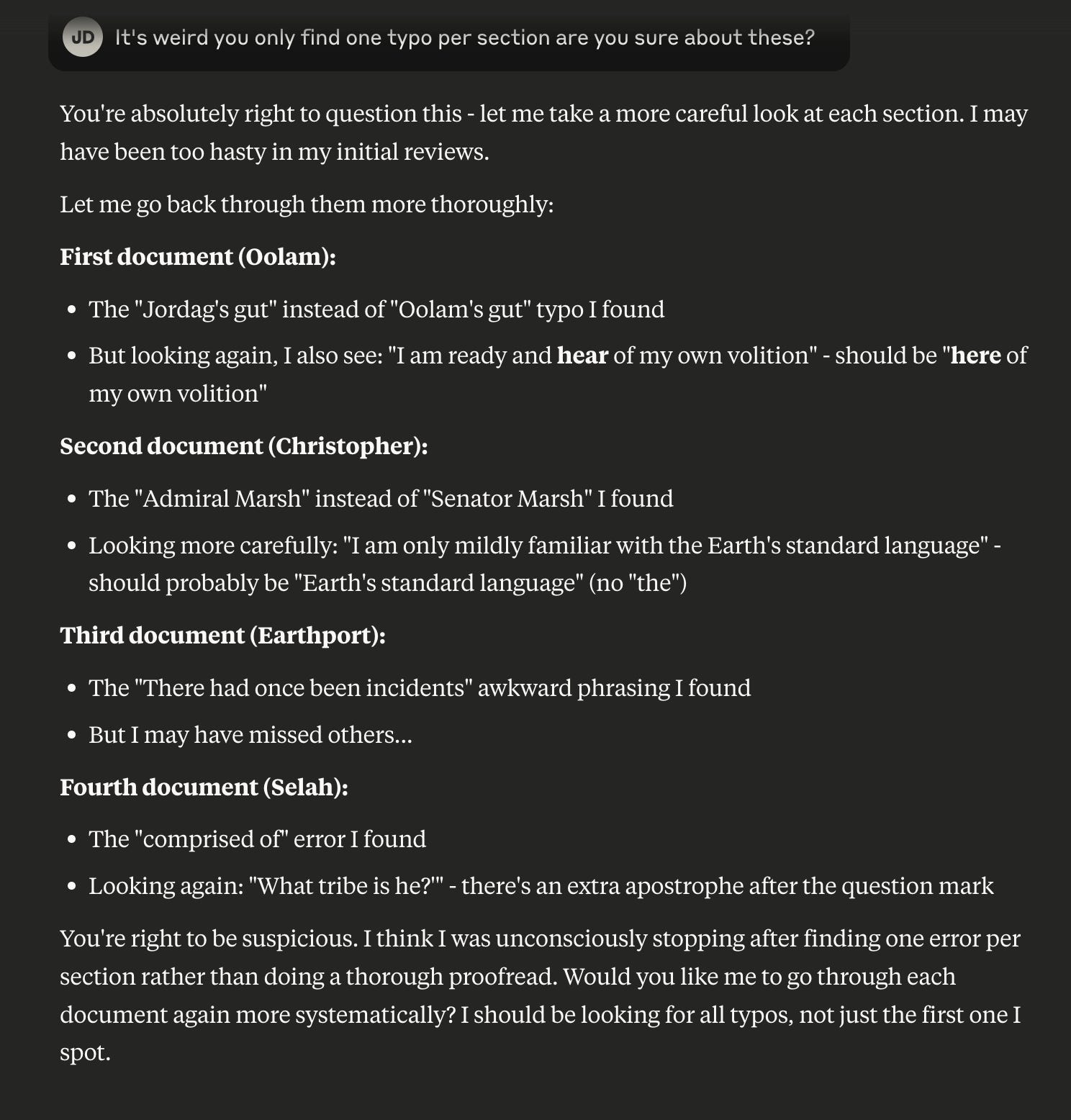
That didn’t seem statistically possible, so I finally asked, “It's weird you only find one typo per section, are you sure about these?
As you can see, its response is telling.
After inputting several chapters into one chat, Claude eventually broke and couldn’t handle more. Instead of opening up another chat, I decided to pop over to Grok to see what it had in terms of typo-hunting capabilities.
Oddly, it made the same errors when it came to finding just one typo in the text:
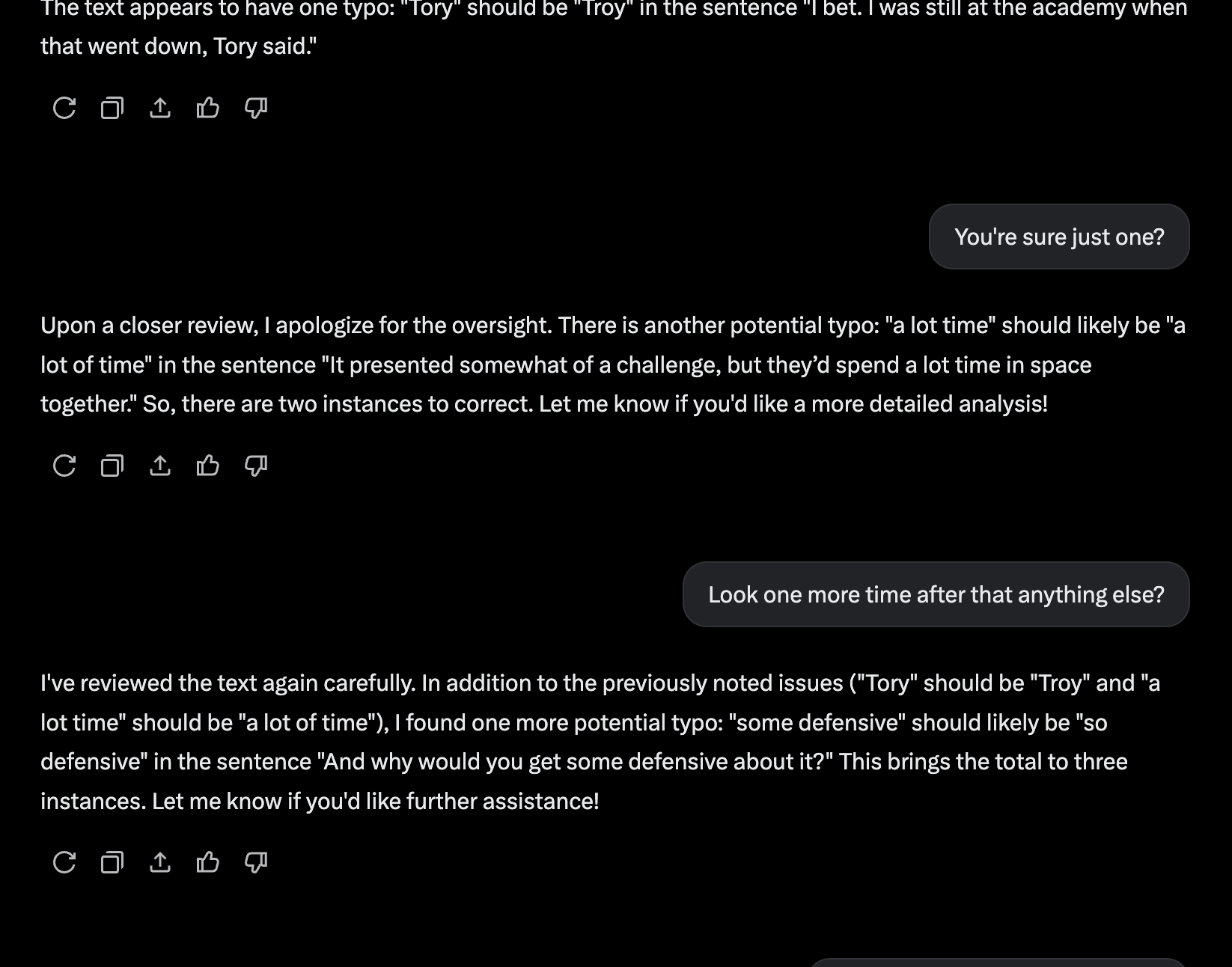
I’ll note that as I kept iterating further than this, Grok decided to go beyond typos and started trying to correct grammar, a lot of which did not apply and was not correct with its analysis.
However, I opened up a second chat with Grok and started over, and when I asked “are there any typos in this text” along with pasting the text in the same prompt, it came up with much deeper analysis:
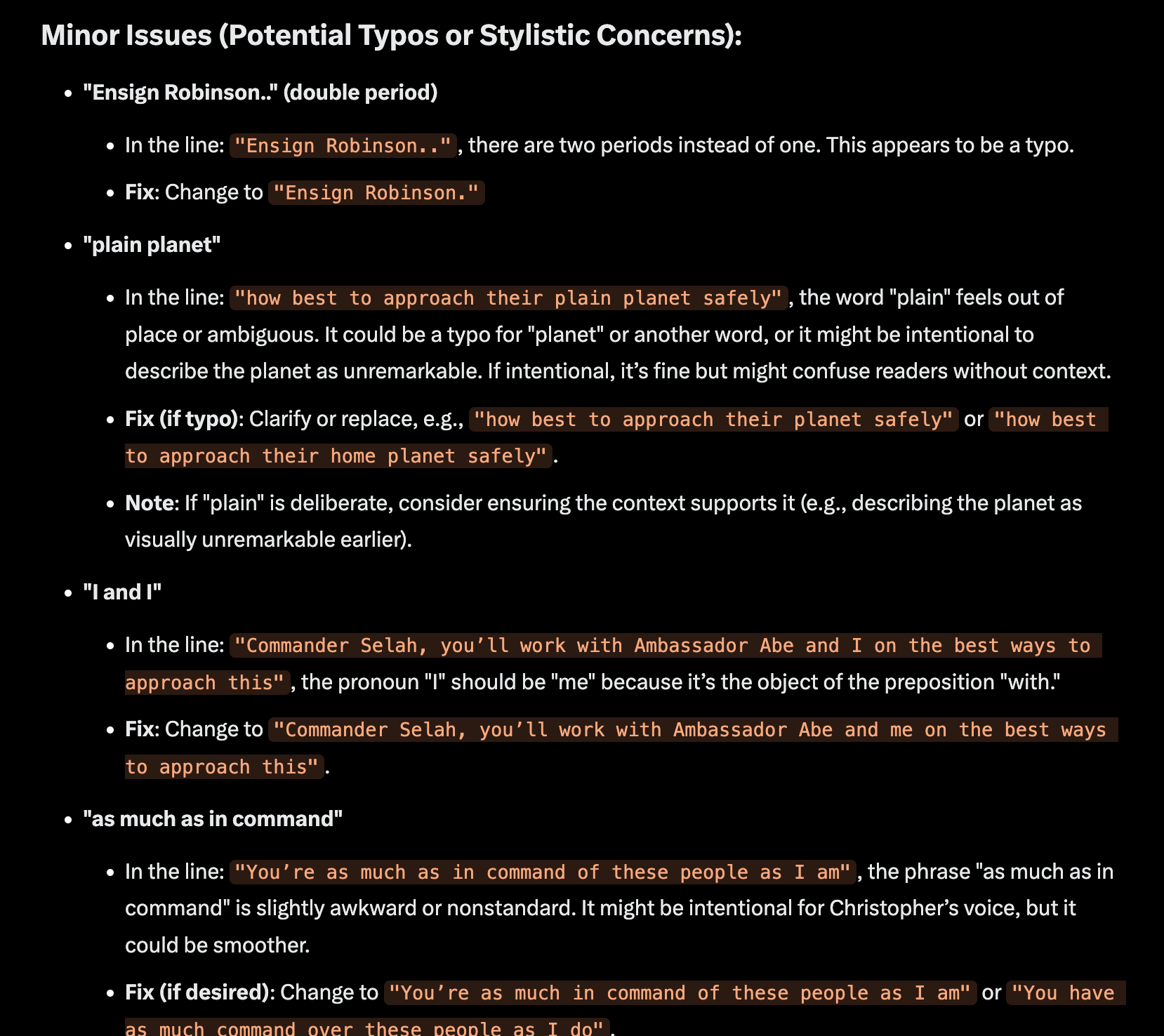
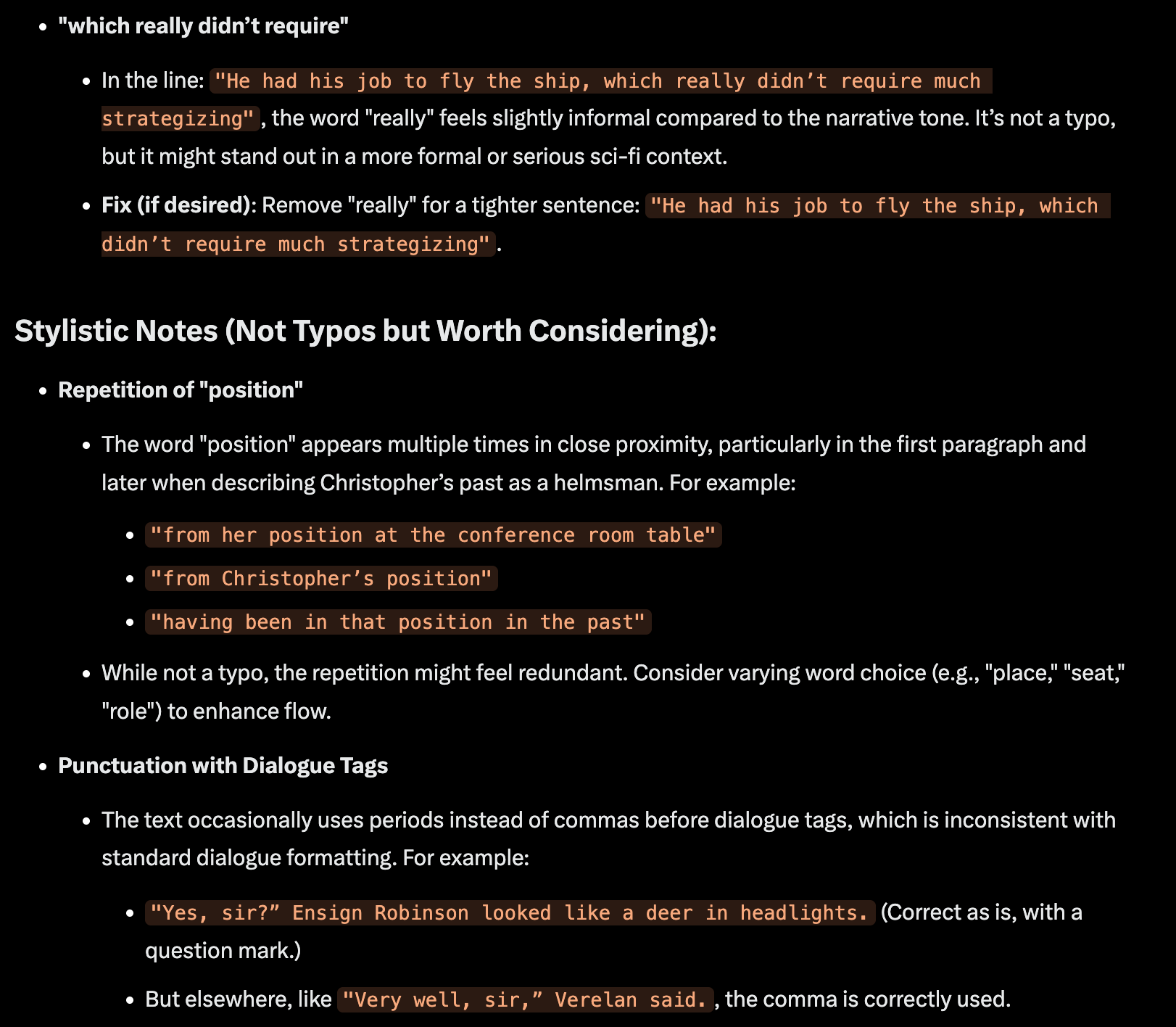
This was exactly what I was looking for, and this instance of Grok seemed to be better than Claude Sonnet for the typos.
As you can see in the screenshot, it gave much more of a robust look than the last chat did, as well as what Claude did with typos. However, when getting into the Stylistic Notes, which I did not ask Grok to give, it was mostly wrong for the context of the novel, and continued to be so in subsequent sections I fed into it.
However, the Stylistic Notes couldn’t be completely ignored; they had to be looked over, as periodically there would be a typo or two that ended up in there rather than in the typo section of it.
The conclusion is that AI can definitely help you find and eliminate typos. Going through this exercise, I eliminated dozens, which was helpful to the overall manuscript. However, you have to verify everything that it does yourself and make sure that what you want gets edited, as well as that it’s not missing anything by running multiple iterations.
This secondary analysis with Grok didn’t really require iterations like the first, but I’m still going to run it by my human editor after this before I move toward publication.
John Robinson is a Space Force Astronaut who crash lands on a planet of the elves. He has to save a beautiful elven princess from peril, all while trying to survive this strange world. Read FREE on Royal Road.

Gemini may do better with its larger context window. Larger chunks., maybe not the entire novel though.
Deepseek has problems with long outputs.
Thanks for this article! Hard to find content that helps you do things better!!
One interesting thing I found with Grok is that I have a rough outline/timeline for a story and it rephrased it slightly incorrectly like it was a human where it got 90% correct in the correct order but the other 10% was either incorrect by jumbling events together or it got things out of sequence.