

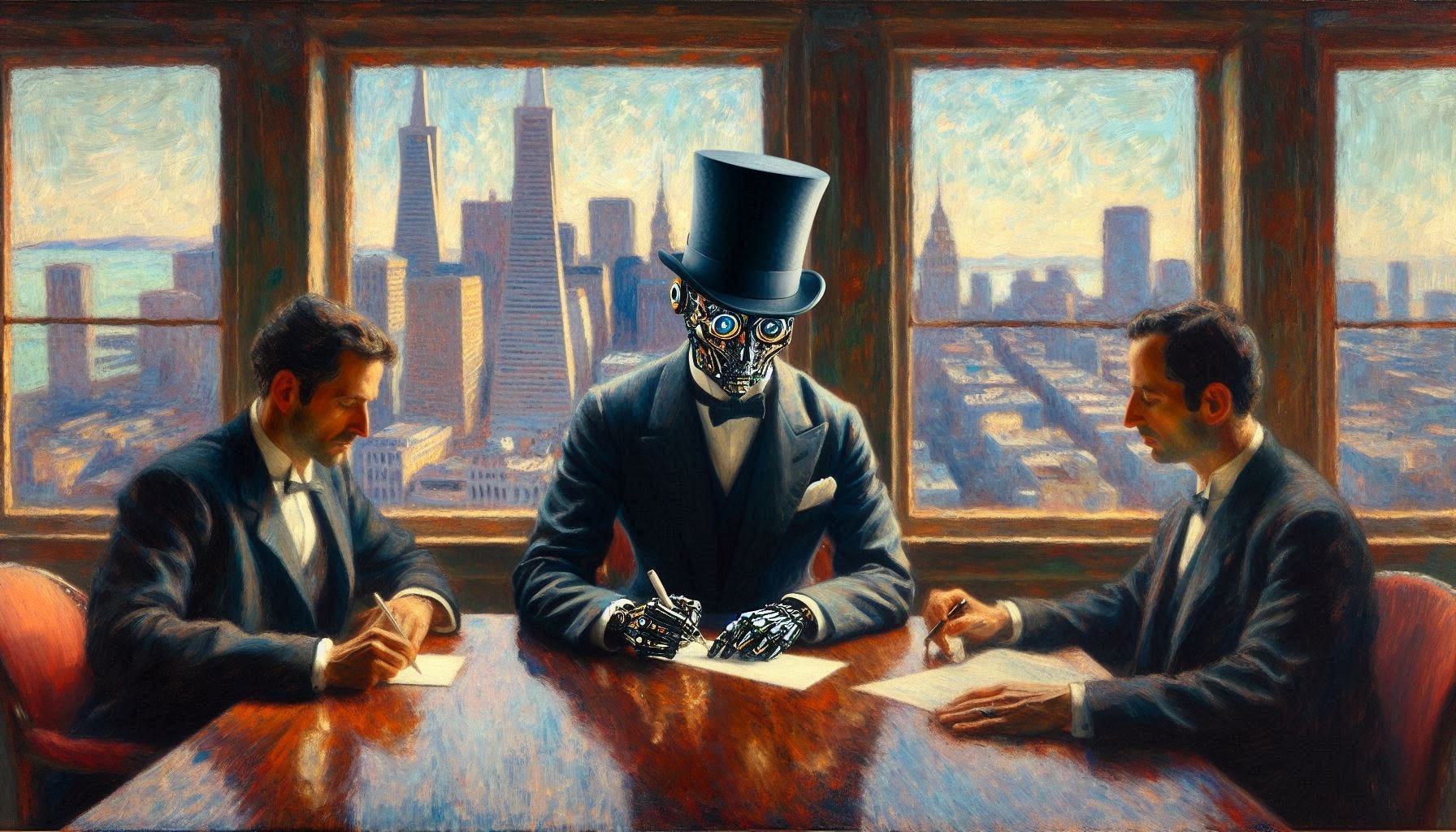
Apparently we’re all working for Anthropic now, as the AI company just agreed to pay out more than the average advance on a new novel per work per author whose works were pirated as part of the initial training process.
In a landmark settlement, Anthropic, a leading artificial intelligence company, has agreed to pay $1.5 billion to a group of authors and publishers after a judge ruled it had illegally downloaded and stored millions of copyrighted books.
The settlement is largest payout in the history of U.S. copyright cases. Anthropic will pay $3,000 per work to 500,000 authors.
The agreement is a turning point in a continuing battle between A.I. companies and copyright holders that spans more than 40 lawsuits across the country. Experts say the agreement could pave the way for more tech companies to pay rights holders through court decisions and settlements or through licensing fees.
“This settlement sends a powerful message to A.I. companies and creators alike that taking copyrighted works from these pirate websites is wrong,” said Justin A. Nelson, a lawyer for the authors who brought the lawsuit against Anthropic.
The settlement came after a ruling in June by Judge William Alsup for the U.S. District Court for the Northern District of California. In a summary judgment, the judge sided with Anthropic, maker of the online chatbot Claude, in significant ways. Most notably, he ruled that when Anthropic acquired copyrighted books legally, the law allowed the company to train A.I. technologies using the books because this transformed them into something new.
“The training use was a fair use,” he wrote. “The technology at issue was among the most transformative many of us will see in our lifetimes.”
But he also found that Anthropic illegally acquired millions of books through online “shadow libraries” like Library Genesis and Pirate Library Mirror that many tech companies have used to supplement the huge amounts of digital text needed to train A.I. technologies. When Anthropic downloaded these libraries, the judge ruled, its executives knew they contained pirated books.
As part of the settlement, Anthropic said that it did not use any pirated works to build A.I. technologies that were publicly released. And anyone still has the right to sue Anthropic if they believe that the company’s technologies are reproducing their works without proper approval. Anthropic also agreed to delete the pirated works it downloaded and stored.
One might think this will significantly change the minds of some of those authors who have been bitterly opposed to AI. I mean, I’ve got 183 works in six languages listed in just one of the public pirate sites, while outspoken anti-AI author Larry Correia has over 1,000. That would mean a payment of more than $3 million to the Monster Hunter International author.
But not so fast… the fine print on the settlement notes that only pirated works that were previously registered with the U.S. Copyright Office will be compensated. Most publishers don’t bother with those formal registrations anymore, especially when they are self-published independents or foreign publishers such as Castalia House. Of the 183 works listed on the pirate sites, which of course, includes duplicates, only 9 of mine are formally registered.
The obvious problem here is that a work does not need to be formally registered with the U.S. Copyright Office to be protected by copyright law; pretty much all of the pirated works will have ISBN numbers and be correctly denoted with the usual “Copyright © xxxx” notice. So I suspect that either the payment restrictions will need to be loosened to include all the pirated works or Anthropic will very soon find itself facing another, even larger lawsuit from which this settlement will not protect them.
In either case, a base price of $3,000 per pirated work has been established. Given that Anthropic recently received more than enough investment to cover both the current settlement as well as any potential larger one, it’s going to be hard to argue that AI is not a very good thing for authors.
Peter Csathy has done a much better job analyzing the legal situation than we have, and here are some of his conclusions about the settlement:
The $1.5 Billion settlement dollars here set the sobering (very) stage for AI companies.
As soon as Judge Alsup certified the case as a class action, everything changed. With that one decision made on a warm summer day in mid-July, Alsup fundamentally changed the case’s dynamics. Instantly, the aggrieved authors and rightsholders were in charge. And the speed — and massive $1.5 Billion — with which Anthropic settled after that decisive ruling (i.e., less than 6 weeks) is an indication that the Bartz plaintiffs got much of what they wanted. Speed tells you a lot in litigation.
The content licensing market for AI usage will accelerate, and those licensing dollars will be bigger.
Anthropic’s massive $1.5 Billion settlement is a legal shot across the bow of all AI developers. All are now on notice of the serious risk that flows from their wholesale dependence on “fair use” to defend their actions. Remember, Judge Alsup, in his rulings prior to the settlement, has been far more sympathetic to Anthropic in its “fair use” arguments than other federal judges who are making decisions on the issue.
As I recently wrote, two other federal judges are far more skeptical of “fair use” as a defense to unlicensed use — Judge Vince Chhabria in particular in the closely-watched Kadrey v. Meta case. So if Anthropic felt the need to settle here, just imagine how other AI developer defendants should feel — particularly Meta. Professor Lee recently posted that, in light of Anthropic’s decision to settle, ChatGPT estimates a 15-20% higher likelihood that OpenAI settles its copyright case with The Authors Guild.
Bottom line lesson for all AI developers. Settle your copyright litigation now to avoid potentially massive legal liability and damages — not to mention, bad legal precedent.
Focus instead on productive content licensing deals — dollars that are much better spent. These proactive dollars are in your best interests anyhow, since they will remove the legal/litigation friction that is holding back adoption of generative AI by major media and entertainment companies, not to mention the Creator Economy in general.
A fair trade..
It is poetic because AI companies need the human production (AI writing would break and degrade the models) and the average human writer does not get paid that much.