

Somewhere this week, someone is training an AI model on photographs of their dog. A few snapshots from different angles, a couple of dollars on a cloud GPU service, and an hour later the model generates images of that specific dog, with its particular markings and lopsided ears, in any setting they can describe. In a different house, someone is setting up a Mac mini to run a private AI chatbot, one that will handle homework questions and meal planning without data leaving the local network. These people belong to a growing movement with its own tools, communities, and competitions. It runs entirely outside the platform economy.
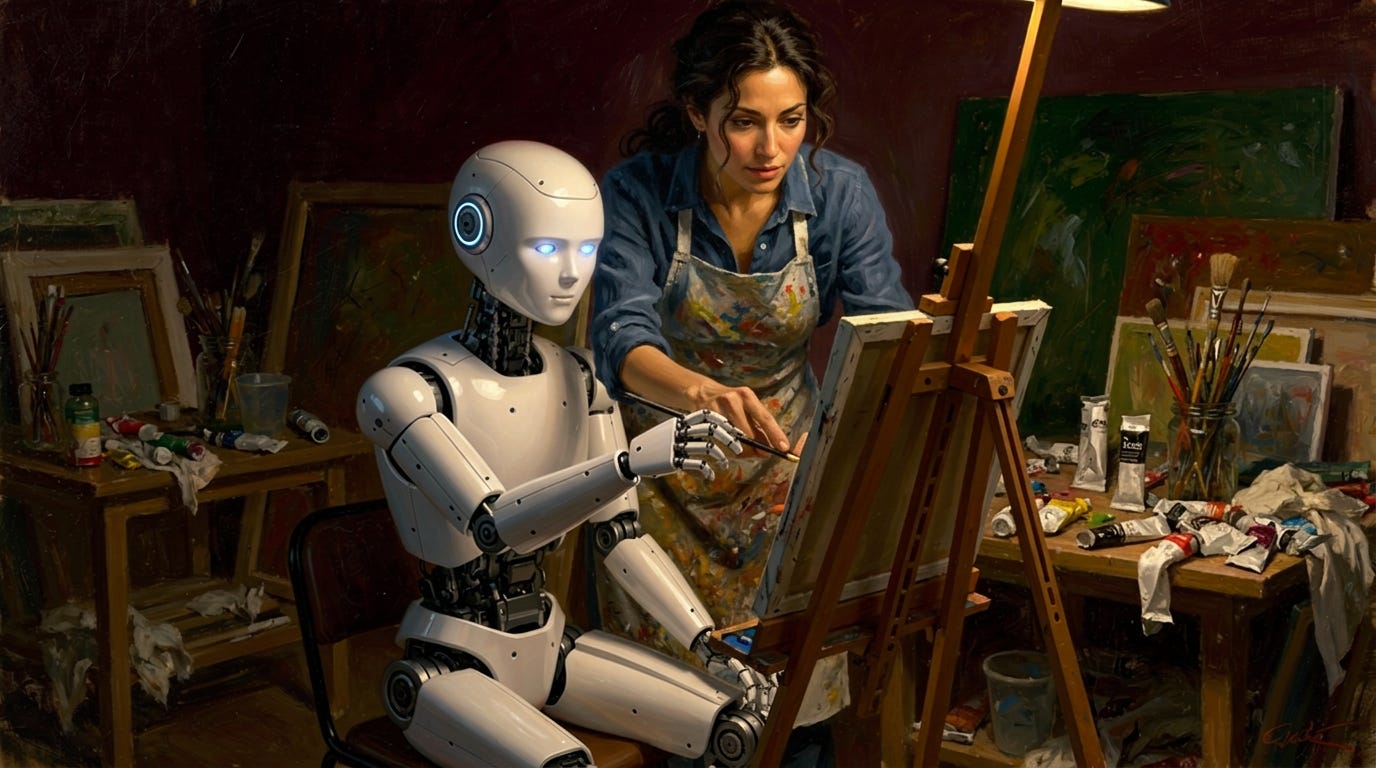
Virtual artists for hire
A LoRA — short for Low-Rank Adaptation — is a small adapter file that teaches an AI image generator a specific look. It can capture a personal art style, a pet’s face, or a custom aesthetic, and training one requires only 15 to 30 reference images. Cloud platforms like Civitai and fal.ai charge $0.50 to $2 per run, and the process takes under an hour. One hobbyist, SophieZ, trained a LoRA on photos of her three cats to generate illustrated stories in Mandarin for her son. She later put the designs on T-shirts. Others train LoRAs on their own artwork, their children’s drawings, or the exact look of their house for architectural mockups.
The community around this hobby has grown its own infrastructure. Civitai, founded in 2022 and backed by Andreessen Horowitz, reached 3 million users within a year and 23.2 million monthly visits by April 2024. ComfyUI, the node-based workflow tool that most hobbyists use to run their trained models, has accumulated 122,000 GitHub stars. A competition earlier this year on ModelScope invited participants to fine-tune image models, with “No GPU” entrants explicitly welcome and prizes that included an iPhone 17 and a PS5.
True autonomy
Running a private AI chatbot at home has consolidated around a standard toolkit. Ollama, released in July 2023, has reached nearly 9 million users and raised $65 million in July. The typical homelab stack has converged: Ollama as the runtime, Open WebUI as the chat interface, n8n for workflow automation, and Whisper.cpp for audio transcription. Installing Ollama and pulling a model takes about ten minutes on a Mac or Linux machine. Together, these tools provide a polished chat interface and automation layer that never leaves the local machine.
The hardware runs on consumer budgets. An M4 Mac mini (starting at $800) runs 32-billion-parameter models at conversational speed while drawing 30 watts at idle. A $2,500 GPU build breaks even against cloud API costs within one to three months of moderate use, after which inference runs at the cost of electricity. The math changed because of quantization, a compression technique that shrinks model weights to fit consumer hardware — a 70-billion-parameter model drops from 140GB to around 40GB with negligible quality loss, and a $700 used RTX 3090 can run it.
Families use these setups for meal planning, homework help, medical record analysis, and email triage. Parents can define exactly how the system responds to their children’s questions, review every conversation, and run the whole thing with no commercial incentive to engage or profile their kids.
Artisanal independence
The LoRA hobbyists and the homelab chatbot builders occupy different corners of AI, but they share an ethic of ownership. They train on their own data, run on their own hardware, and answer to no platform’s terms of service. Most people will keep using ChatGPT and Midjourney, the same way most people buy their beer at the store. The parallel to homebrewing and ham radio runs deeper than the surface resemblance: in each case, a small community chose to build what it could buy and discovered that the building was the better half of the experience.