

AI solved 3D printing’s design barrier for figurines and props earlier this summer. Text-to-3D generators can turn a sentence into a printable mesh in under a minute, and print-monitoring neural networks watch for failures overnight. Those capabilities addressed the artistic half of fabrication, the domain where aesthetics matter and dimensions do not. The engineering half operates under different rules. A replacement hinge for an industrial enclosure must tolerate specific loads, mate with existing bolt patterns, and survive whichever manufacturing process produces it, whether injection molding, CNC machining, or additive fabrication. Each process imposes its own geometric constraints. AI has arrived in this domain too. The tools now generate real, downloadable solid models, which makes the gap between a shape file and an engineered part newly visible.
Outside tolerance
Zoo, formerly KittyCAD, generates boundary-representation geometry from text prompts and exports it as STEP files. Boundary representation, or B-Rep, defines a solid by its surfaces, edges, and vertices rather than as a mesh of triangles, which means that the output imports into professional CAD environments as native geometry with mathematical precision rather than as an approximation. Adam by Datagrok and Spectral Labs’ SGS-1 take different approaches to the same problem, and together the three tools make 2026 the first year in which text-to-CAD produces geometry that an engineer can download and manipulate rather than merely watch in a demo.
A hands-on comparison found that the same prompt run twice through Zoo produces noticeably different geometry, a consistency failure ruling out standardization for production use. Every text-to-CAD engine in the category generates shapes without feature trees, dimensional tolerances, material callouts, or assembly relationships. The output carries no record of how it was constructed, no specification of how tightly each dimension must be held, and no indication of which material should be used. An engineer receives a solid body, divorced from the information that would make it a part.
Purely visual resemblance
A generated bracket can have wall sections too thin for injection molding, sharp internal corners that concentrate stress under cyclic loading, and geometry that no available machining operation can reproduce. These failures share a root cause. The generation models learned the visual distribution of engineering parts from training data rather than the physics of materials or the constraints of fabrication processes. They produce geometry that resembles a part the way a photograph of a key resembles a key.
MIT’s MechStyle system, published in January, puts a number on this gap. CSAIL researchers found that only 26% of AI-stylized 3D models remained structurally viable after generation, meaning that nearly three in four would fail under real-world loads. MechStyle addresses structural viability by running finite element analysis during modification, identifying regions where aesthetic changes weaken load-bearing geometry, and constraining further changes to preserve integrity. Across 30 test models with styles resembling brick, stone, and cactus textures, the system achieved 100% viability. MechStyle, however, refines existing geometry rather than generating from scratch. Structural integrity is one of several engineering dimensions, alongside manufacturability and dimensional tolerance, that text-to-CAD tools cannot yet address.
Designed for real tools
Fusion 360’s generative design takes a fundamentally different approach. The engineer specifies preserve regions, obstacle regions, load cases, materials, and manufacturing method before the solver runs. Manufacturing methods include 2.5-axis milling, 3-axis milling, unrestricted additive, and die casting with parting directions, and the algorithm constrains its topology exploration to geometry that the specified process can produce. The output lands closer to fabrication-readiness than anything text-to-CAD generates because the manufacturing method functions as a boundary condition rather than an afterthought. A solver constrained to 2.5-axis milling, for instance, produces geometry with no internal voids or undercuts, because the tool cannot reach them. The engineer’s judgment still closes the final distance, since generative design produces mesh geometry requiring conversion to parametric CAD before it reaches a shop floor.
Leo AI’s geometry-aware search addresses the problem from a different angle. The platform reads B-Rep CAD geometry directly and searches an organization’s existing vault by shape rather than by part number or file name. Sixty to eighty percent of new engineering parts are variations of designs that already exist, which makes retrieval and adaptation a higher-value capability than generation for most organizations. A part pulled from an existing vault already carries the tolerances, material specifications, feature history, and assembly context that no generative tool can yet produce.
Division of tasks
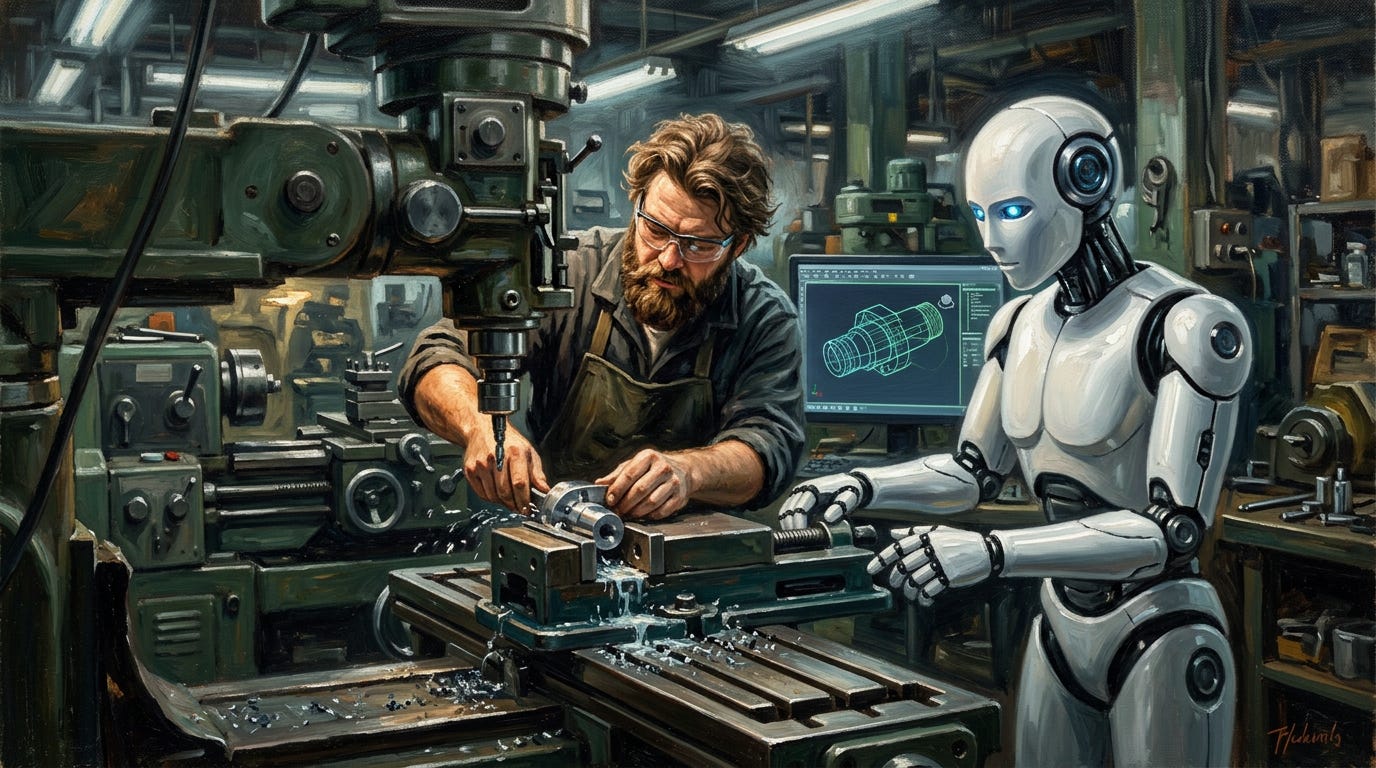
Fusion’s manufacturing constraints and MechStyle’s structural simulation represent the same trajectory. Both embed a category of engineering knowledge into the generation loop, narrowing the gap between generated geometry and fabrication-ready design. Future tools will likely absorb additional categories, such as dimensional tolerance, assembly fit, and surface finish, as the field matures. The engineer’s role changes shape accordingly. Specifying which constraints apply, evaluating the candidates that a solver produces, and converting optimized geometry into fabrication-ready parametric CAD all require judgment that computation cannot supply. AI in parts engineering has settled into a division of labor in which the machine explores the solution space and the engineer decides which solutions actually work.