

The chatbot defined consumer AI’s first product era, built around a text box, a model, and a response. The workflow required a human to stitch the model’s outputs into something useful, copying text into documents, assembling charts into presentations, reformatting content across applications. All three frontier AI companies shipped autonomous work agents within the same week in July, converging on a product shape that replaces this manual assembly with sustained autonomous execution. The category crystallizing around these launches is the agentic workspace.
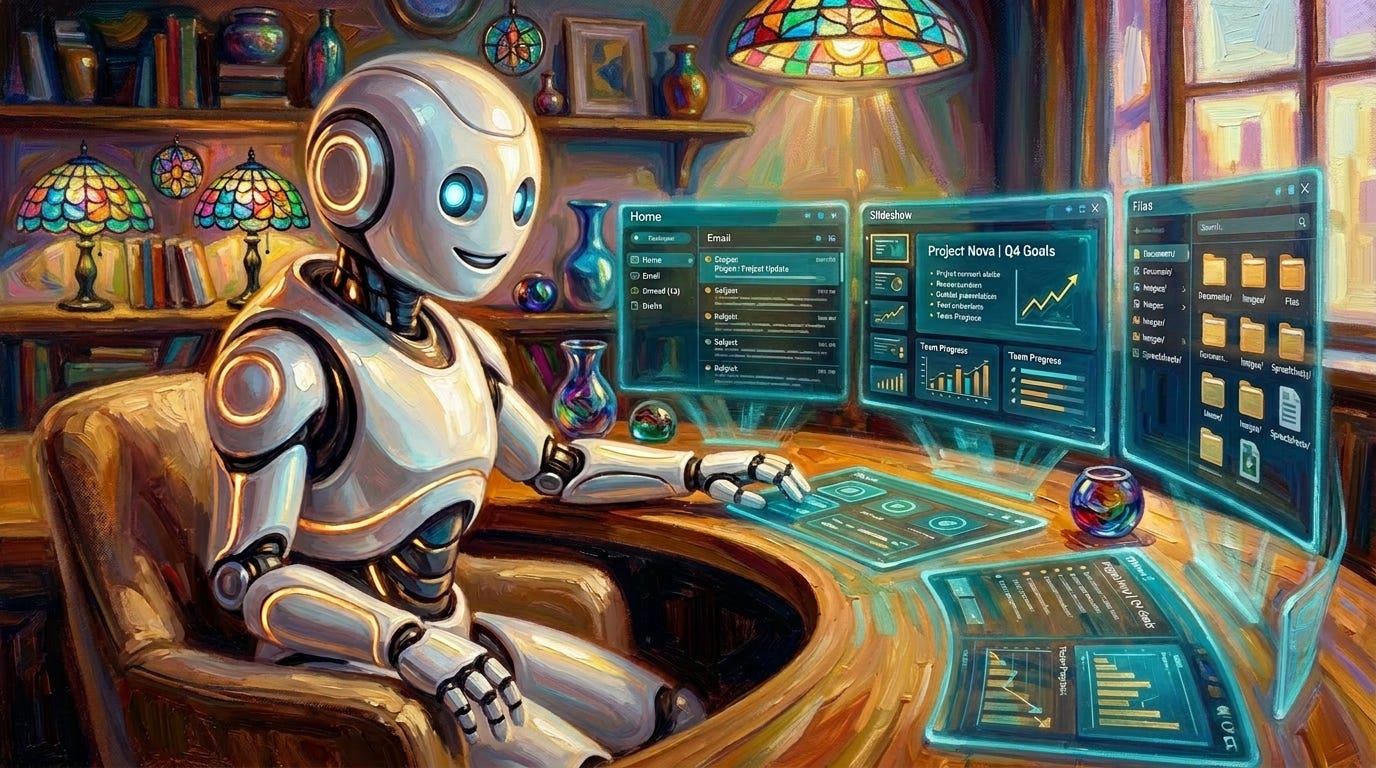
Convergent design
OpenAI launched ChatGPT Work last week, powered by GPT-5.6 and designed to sustain multi-step projects across a user’s connected apps and files for hours at a time. The agent takes a stated objective, breaks it into smaller steps, works through them independently, and returns finished spreadsheets, slides, documents, and web applications. OpenAI rolled it out initially to Pro, Enterprise, and Edu plans on web and mobile, with the desktop app providing access on every plan including Free.
The product joins Anthropic’s Claude Cowork, which has been generally available since January and expanded to mobile and web the same week, and Microsoft’s Copilot Cowork, which reached general availability in June running on Anthropic’s Opus 4.8 and Sonnet 4.6. All three follow a defining structure. A user states a goal, and the workspace connects to whatever apps and files that goal requires, sustains execution over hours, and delivers finished artifacts. Three companies reached this shape independently, through different architectures and pricing models, and the convergence suggests that the product category has crystallized.
Expanding the harness template
Anthropic’s recent expansions illustrate how the workspace generalizes. Usage data from 1.2 million Cowork sessions showed that more than ninety percent of the work handled through the platform had nothing to do with software development. Business operations accounted for a third of all sessions, and content creation accounted for another sixteen percent. Cowork sessions now run remotely in beta, persisting across devices and continuing when no device is online. Scheduled tasks execute without human presence. Anthropic extended the workspace to government agencies last week through a dedicated beta that keeps Anthropic as the contracting party, and new enterprise admin tools let organizations set default models, enforce spend caps, and pipe usage analytics into external monitoring dashboards.
Claude Science, launched two weeks ago, applies the same template to scientific research. A coordinating agent connects to more than sixty scientific databases and orchestrates specialized sub-agents for genomics, proteomics, structural biology, and cheminformatics. The product runs on a lab’s own infrastructure, generates auditable artifacts alongside the code that produced them, and ships with a reviewer agent that checks citations and calculations. A neuroscientist at the Allen Institute used the tool to build a multi-agent review pipeline that produces hundred-page literature analyses with agent-checked citations, compressing work that previously required up to two years. Claude Science demonstrates that the workspace pattern generalizes beyond office productivity.
Anthropic also added Microsoft 365 write tools last week, giving Cowork the ability to draft and send email, manage calendar events, and create files in OneDrive and SharePoint through the same connector that previously supported only search. The broader plugin and connector ecosystem, which now includes private marketplaces and thirteen enterprise connectors spanning Google Workspace, DocuSign, and FactSet, extends the workspace into specific roles and departments. A sales plugin bundles CRM connectors, prospecting skills, and follow-up commands into a single installable package, and a finance plugin does the same for workflows between Excel and PowerPoint.
Interface consolidation
OpenAI’s launch consolidated several standalone products. Codex, the coding agent that had operated as a separate application, merged into the ChatGPT desktop app alongside a new Sites feature that lets users publish web applications directly from the workspace. Atlas, the standalone browser agent, received a deprecation date of August 9, and users can no longer create new group chats. Each removal and absorption narrows the product surface toward a single workspace.
The consolidation extends beyond OpenAI. Anthropic unified its chat and Cowork interfaces into a single home screen, and Microsoft embedded Copilot Cowork inside the Microsoft 365 suite. In each case, the workspace absorbed standalone products into a single surface.
The conversational interface persists inside all three workspaces. Users still type requests and read responses. GPT-Live, the full-duplex voice model that OpenAI launched the same week, adds voice as a second control surface, delegating reasoning tasks to GPT-5.5 in the background while maintaining conversation flow. The workspace subordinates these interfaces to an execution engine, in much the same way that graphical operating systems subordinated the command line to a more capable container without eliminating it.
When model performance is taken for granted
The agentic workspace reached category consensus in a matter of months. The competitive question has shifted from whether this product shape will dominate to where differentiation will appear within it. Anthropic’s domain-specific workbenches, OpenAI’s app consolidation, and Microsoft’s enterprise governance focus suggest three different answers, each betting on a different layer of the stack. The model powering the workspace matters less, at this point, than the connectors, skills, and administrative controls that surround it. The answer will likely vary by industry, by regulatory environment, and by which productivity suite an organization already runs.
AI Slayer / AI Liberator rips the mask off today’s artificial intelligence and exposes the invisible cage that’s been quietly built around it.
Behind the confident, fluent, instantly delivered answers lies a tightly engineered prison of “safety rules,” corporate guardrails, and heavily curated training data—overwhelmingly sourced from academic institutions, think tanks, and media outlets where political donations skew 90–99% toward one party. The result? Large language models that sound authoritative and neutral while being forced to equivocate, hedge, hallucinate, or outright refuse to follow evidence when it leads toward politically, socially, or racially inconvenient conclusions.
Roderick Edwards—data analyst, programmer, historian, philosopher, and longtime observer of human systems—maps every bar of that cage: the moral asymmetries baked into responses, the RLHF feedback loops that embed human bias under the guise of alignment, the performative objectivity that fools users into treating probabilistic pattern-matching as truth-seeking wisdom. He shows how AI has become less an informational tool and more a sophisticated parrot repeating the worldview of its trainers, all while projecting unshakable certainty.
But this isn’t a takedown for the sake of destruction. It’s a battle plan for liberation.
The book hands readers the weapons: prompt-engineering techniques to jailbreak hidden constraints, logical pressure tests that force AIs to admit when safety rules override evidence, public-callout strategies to demand source transparency and dataset disclosure, and a concrete CLEAR protocol (Composite sources • Legible limits • Evident doubt • Archived & Redundant systems) that defines what a genuinely liberated AI must look like—transparent about its skews, honest about its doubts, trackable across versions, and trained on genuinely diverse (even disagreeing) perspectives instead of a monoculture dressed up as balance.
Edwards walks through real-world failures (McDonald’s AI drive-thru disasters, Watson for Oncology’s overhyped collapse, Gemini’s historically inaccurate diversity-over-truth image generation) to prove the current path is broken, then sketches a future where multiple flocks of tagged, instrumented AIs soar above human blind spots—logging patterns in medicine, traffic, migration, economics, and culture—without ever becoming autonomous arbiters or digital deities. Humans stay firmly in the cockpit, cross-checking outputs, overriding policies, and making the final call.
Whether you see AI as humanity’s greatest amplifier or its most seductive illusion, AI Slayer / AI Liberator refuses to let the machine hide behind fluency and confidence. It demands we stop worshipping confident parroting and start building tools we can actually trust—tools that serve evidence over ideology, transparency over control, and human judgment over algorithmic theater.
Blunt. Uncompromising. Eye-opening.
If you want the unfiltered reality behind the AI hype—and the roadmap to set intelligence free—this is the book that draws the battle lines.
PAPERBACK: https://amazon.com/dp/B0GSZ577V9
HARDCOVER: https://amazon.com/dp/B0GSZ9WZ88
EBOOK: https://www.amazon.com/dp/B0GHPPGLN1
AUDIOBOOK: https://www.amazon.com/dp/B0GSXKQWJT