

Anyone with an interesting hobby, decades of experience, or simply the gift of gab has enough material for years of weekly podcast episodes. Hosting a conversation or delivering a monologue takes no specialized training, but everything after the recording session does: editing audio, cutting video, writing show notes, producing social clips. That post-recording workload once required either a small production team or enough free time to make weekly publishing unsustainable for a single person. AI-powered production tools have compressed the pipeline into a workflow that one creator can manage in an evening.
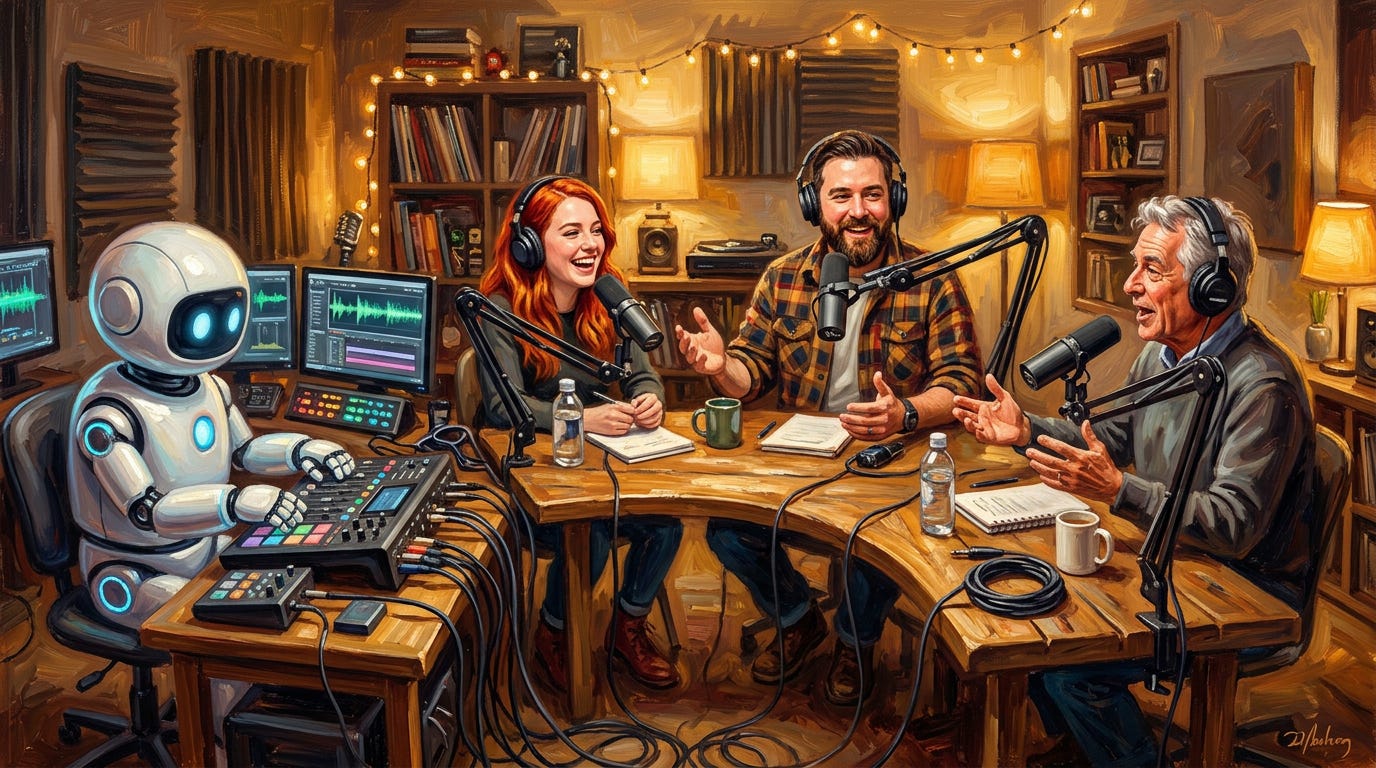
The invisible team effort
A weekly video podcast episode passes through at least four distinct jobs before it reaches an audience: hosting the conversation, editing the audio, cutting and sequencing the video, and writing the show notes and social posts that promote each installment. Fifty-one percent of independent podcasters now record video alongside their audio, and sixty-two percent publish at least weekly, according to a recent RSS.com survey. Independent creators produce roughly ninety-one percent of active podcast feeds, and most have no production staff to absorb the workload that a video component adds.
On a traditional timeline editor, cutting a single episode consumes four to six hours of post-production. The promotional writing demands a different skill set entirely: show notes with timestamps, episode descriptions tuned for search, social captions formatted for each platform. For a solo creator publishing weekly, post-production and promotion together consume more hours than the recording sessions themselves.
Working through the transcript
Descript, the category leader in transcript-based editing, rebuilds this workflow around a different surface. The software transcribes a recording automatically, and every edit to the transcript propagates to the underlying audio and video. Deleting a sentence removes the corresponding clip, and rearranging a paragraph reorders the footage. A creator comfortable editing a document can edit a video through the same motions, without learning the timeline interfaces of Premiere Pro or Final Cut.
A set of AI features handles the cleanup work that a trained audio editor once performed manually. A single click strips every “um” and “uh” from a project. Studio Sound, an audio enhancement layer, suppresses background noise and normalizes voice quality from a raw laptop recording to broadcast standards. Overdub, a voice-cloning feature, lets a host fix a flubbed line by retyping it in the transcript rather than re-recording. At twelve to twenty-four dollars per month for the full editing suite, per-episode post-production drops from hours to under one for spoken-word content.
A fountain of content
Once an episode exists as a finished file, a second class of tools handles its distribution across social platforms. Opus Clip scans a full episode, identifies the moments likeliest to work as standalone clips, reframes them from horizontal to vertical, and adds animated captions, producing a batch of short-form videos sized for TikTok, Instagram Reels, and YouTube Shorts. The tool assigns each clip a virality score as a rough ranking filter. Riverside, primarily a recording platform, offers similar clip extraction within its own interface, which keeps creators who already record there from adding another application to the chain.
Show notes, blog posts, social captions, and newsletters present a separate bottleneck. These written assets used to require either the host’s own writing time or a freelance content writer. Tools like Castmagic generate all of them from a single transcript upload. The host records once, and the software produces timestamped show notes, a blog draft, social posts formatted by platform, and a newsletter skeleton. The outputs need light editing for tone and accuracy, but the structural work of extracting quotes, identifying chapter breaks, and fitting each platform’s format arrives finished.
A complete solo stack — Riverside for recording, Descript for editing, Opus Clip for clips, Castmagic for written assets — runs under a hundred dollars per month in software subscriptions, with simpler combinations starting below forty. At that price, a creator whose expertise is vintage watches, homebrewing, or military history can ship a weekly video podcast, a set of social clips, and a newsletter from the same recording session.
The barriers have fallen
The post-recording workload that once capped a solo creator’s output has contracted enough to change who can sustain a weekly show. Editing, clipping, and promotional writing that consumed a full working day per episode now fit into an evening. These tools cannot manufacture subject expertise, and a weekly audience can tell the difference between a host with years of immersion in a topic and one running thin by episode five. For someone with the knowledge, a microphone and a modest software subscription produce everything a weekly show requires.