

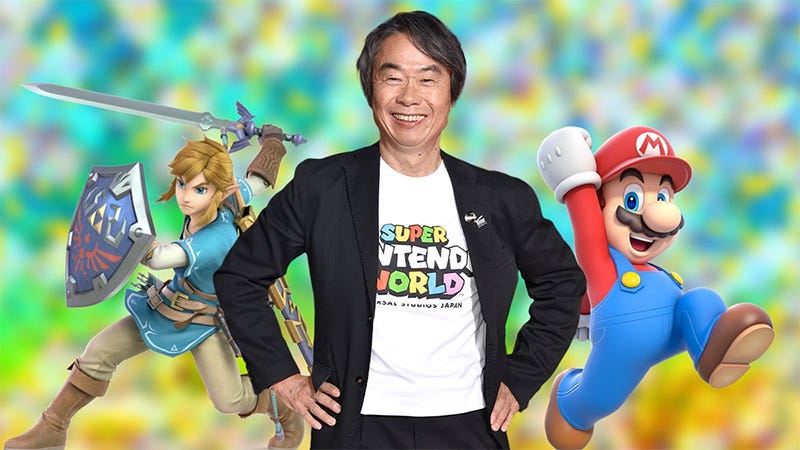
Shigeru Miyamoto is one of the greatest game designers in history. As the lead designer at Nintendo, Donkey Kong, The Legend of Zelda, Mario Bros. and Star Fox are just a few of his dozens of game development credits. In a recent interview, he explained why he thinks AI is a great thing for game development.
Computers came along during my gen eration. Before that, people typed on typewriters. Then word processors came along, and so on. Tools have continued to evolve, one after another.
For example, designers used to learn something called lettering in school—the art of drawing letters beautifully, like the lettering on a poster If you could do that, you could already be called a designer. Similarly, if you could take a typeface that was popular overseas, adapt it to Japanese, and arrange it into a layout, you might be called a designer simply because you could do that.
But as computers continued to evolve, so did word-processing software. Eventually, computers could copy text from somewhere else, pull in images, and render lettering beautifully for you. As these technical and practical skills continued to advance, things like a person’s sense of layout and their individual design abilities finally began to come to the fore.
So even if a husband is a designer and his wife takes care of the household, it’s entirely possible that his wife actually has a better eye for design than he does. I sometimes worry about whether that might be true in my own case, too. As things like this happen more and more, the tools change the way we work.
That’s exactly what’s happening with Al. We’ve always made a distinction between creating something and doing the work.
When you set out to create something, you first put together the overall structure, right? Then you start arranging things toward a particular goal. Everything that comes after that is the actual work: filling in the gaps, polishing things up, and so on.
The tricky thing is that the work itself is enjoyable. There’s a sense of satisfaction that comes from making something, isn’t there? For writers and all of you here, too.
But what worries me is that people can become so satisfied with the work itself that they start mistaking that satisfaction for having created something good. That’s what I’m afraid of.
So, in that sense, the more Al takes care of all kinds of tasks for us, the more opportunities we all have to think seriously about what it really means to create something. I think that’s a very good thing.
Looking back at design history, there must have been plenty of designs that emerged simply by copying existing work. But those designs don’t really stand the test of time, do they?
What makes a design endure is that an individual sets out to design something with a clear intention. The computer then helps them carry out the work. That’s the underlying structure.
No matter how far technology advances that basic principle will remain—although, well, who knows? Al might eventually end up doing absolutely everything in that process, too. (Laughs.) But for now, I think there’s still plenty that we humans can do.
He gets it.
Why do I feel like he got the invincibility star before he started the interview?