


Elliott stared at her, waiting for the punchline. When none came, he shook his head. "That's absurd."
"Is it?" Sofia asked. "You're a scientist, Elliott. You've dedicated your life and your company to extending human longevity. Is it so impossible to believe that someone might have discovered the secret before you?"
"Yes," he said firmly. "It is. The technology didn’t exist until recently. Cellular regeneration on that scale would be—"
"It's not regeneration at all," she interrupted. "It's a transformation. A fundamental alteration of what it means to be human."
Elliott's analytical mind raced, cataloging details that had seemed merely eccentric before: Medici's archaic speech patterns, his old-world formality, the casual references to historical events as if he'd witnessed them firsthand. The strange stillness of everyone at the dinner table. Their unnatural focus. Their collective disinterest in utilizing the precious technology for themselves.
"This is insane," he said, but with less conviction.
Sofia moved closer, her eyes never leaving his. "You haven't asked the obvious question, Elliott. If Lorenzo has lived for nearly six hundred years, how old am I? How old do you think I am?"
He studied her face—the flawless skin, the ancient eyes that seemed at odds with her youthful appearance. "I don't know. You can't be more than thirty."
She smiled, a sad, knowing smile. "I was born in 1791. In Venice. During the last days of the Republic."
Elliott's scientific mind rebelled. "That's impossible. You'd be—"
"Two hundred and thirty-four years old," she finished for him. "Yes. I am."
"Bullshit," he said flatly. "I don't know what game you people are playing, but I'm not buying it."
Sofia sighed, as if she'd expected his reaction. "Would it help if I showed you something?"
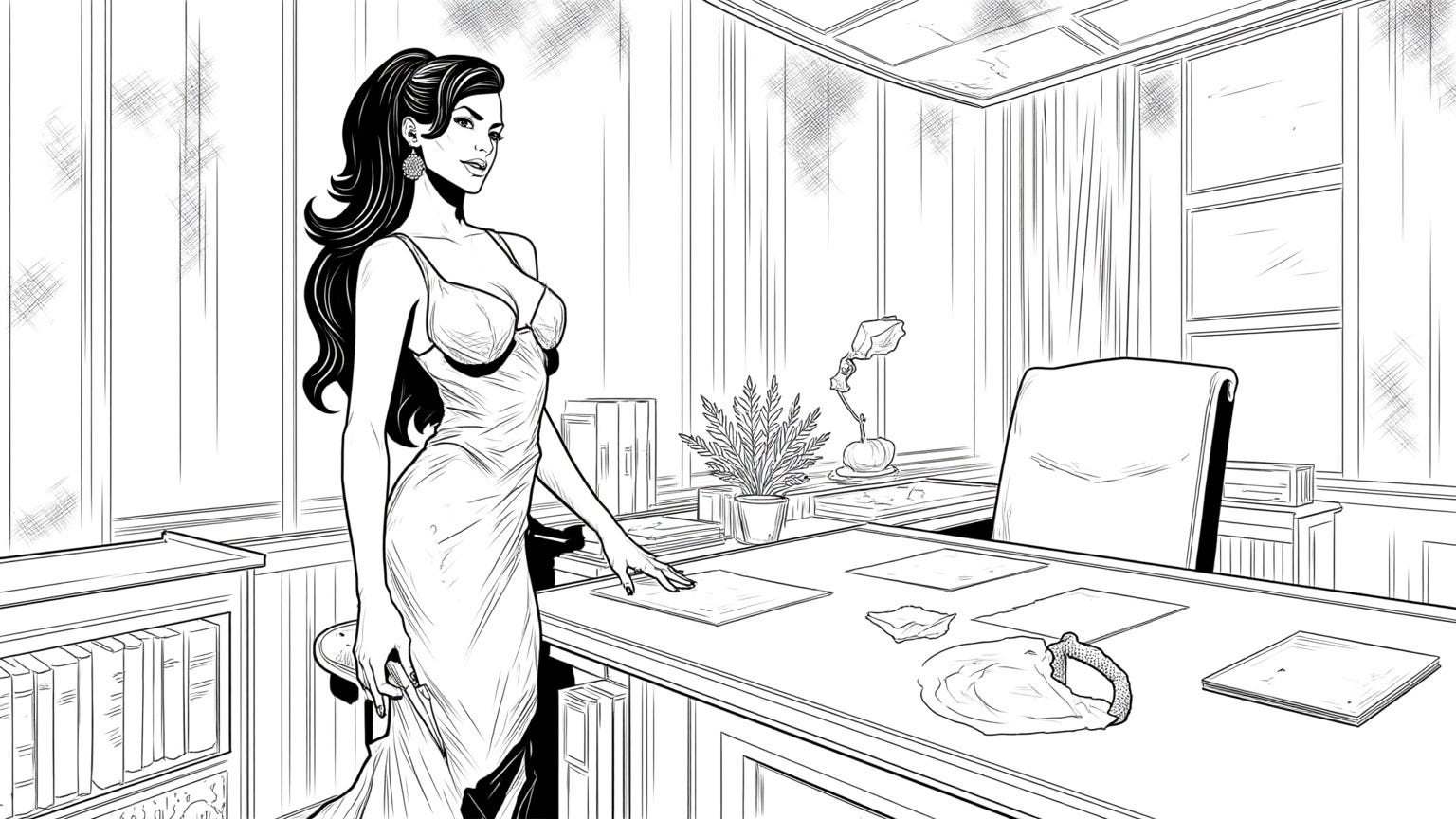
Before he could respond, she moved to the desk and picked up a letter opener—a wicked little thing with an ivory handle and a razor-sharp blade. With a swift, decisive motion, she drew it across her palm, deep enough that blood welled instantly, dripping onto the antique rug.
"Jesus!" Elliott exclaimed, instinctively moving toward her. "What the hell are you doing?"
"Watch closely," she commanded, holding her bleeding hand before him.
To his astonishment, the blood flow slowed, then stopped entirely. As he stared, the edges of the wound began to draw together, knitting before his eyes. Within seconds, the slash had closed completely, leaving only a thin red line that was already fading.
Elliott seized her hand, examining it carefully with the critical eye of a practiced scientist. No trick photography. No sleight of hand. The layers of skin were genuinely healing at an impossible rate.
"Cellular regeneration," he murmured, his mind racing through possible explanations. "Some kind of accelerated platelet response? Or maybe a synthetic clotting agent under your skin?"
Sofia withdrew her hand gently. "This isn’t technology, Elliott. It’s biology. Just not human biology—at least, not entirely."
"Then what is it?" he demanded, his voice barely above a whisper. “What are you?”
She held his gaze. "You already know. You've known since you were a child, reading stories under your blankets with a flashlight. Every culture has a name for us. Every society tells its tales about us. We are the ones who live in darkness. We are the ones who walk in shadows. We are the ones who do not die."
Elliott's throat was suddenly dry. "You're trying to tell me you're... what? Vampires? Are you serious?"
Even as the ridiculous word left his mouth, he felt a curious sense of déjà vu. Hadn't this been the very suspicion that had first drawn him to digging more deeply Theranos? Not vampires specifically, of course, but the idea that all those ancient men on its board had been seeking something beyond mere profit—something that would give them more of the one commodity no amount of money could buy: time.
Sofia nodded, her expression entirely serious as she returned the letter opener to the desk. "We don’t call ourselves that, of course. But yes, the folklore with which you are familiar mostly stems from encounters with our kind."

"That's..." Elliott ran a hand through his hair, struggling to reconcile the scientific improbability of what she was suggesting with the evidence of his own eyes. "That's not impossible, necessarily."
"Yes," she said softly, "you're already trying to work out the biological mechanisms that would make it possible, aren't you? The innovator in you can't help but seek to unravel the mystery."
She was right. His mind was already racing, assembling a theoretical framework—some kind of parasitic symbiosis, perhaps, or a viral vector that fundamentally altered cellular structure, slowing telomere degradation while accelerating healing. The accelerated platelet response alone would be revolutionary if it could be isolated and replicated.
"Let's say, hypothetically, that I take you at your word," he said carefully. "What does this have to do with my research? With HemaTech?"
Sofia's expression turned grave. "Your mRNA therapies. The crocodile encodings you've been studying. They're particularly effective, aren't they?"
Elliott stiffened. "How could you possibly know that? Those results aren't even in our published papers."
"Because," she said, "those same genetic sequences are present in us. Not identical, but similar enough that your research has inadvertently uncovered some of the basic elements of our biological mechanism. If your therapies were to become widely available, it would only be a matter of time before someone made the connection." She paused. "And once they do, they'll start looking for us. Then it will only be a matter of time before they find us."
The implications suddenly dawned on him. They were appalling. "You think I've discovered how you... work?"
"Not entirely," Sofia said. "But you are close enough to make our exposure inevitable. Close enough to give others a roadmap to finding us. And in a world of eight billion people with ubiquitous surveillance and DNA databases, that exposure would be catastrophic."
Elliott paced the room, his mind working furiously. "So Medici's offer..."
"Is intended to contain your work," she confirmed. "To ensure that it will never go public, never appear in the science journals, and never grow into the massive industry it would otherwise become."
"And if I refuse?"
Sofia's expression was entirely placid. "Then both you and your research will be buried. Metaphorically and literally."
The threat couldn't have been clearer, for all that it was delicately delivered. Elliott moved to one of the windows, staring out at the darkened garden below. In the moonlight, he could make out several figures moving with predatory grace among the hedges—the security detail, he had assumed. Now he wondered what they truly were.
"I’ll bet that’s why they were so interested in Theranos," he murmured, more to himself than to Sofia. "Her high-powered board. Holmes must have stumbled onto something similar in her blood analysis. Something that could have exposed them."
"She did," Sofia confirmed. "Though unlike you, she never understood the significance of what she'd found. We made certain the technology failed catastrophically before she or anyone else did. Once it was established that she was merely a fraud, there was no further interest in following her path."
“But she wasn’t a fraud.” Elliott turned back to her, his expression hardening. "She was onto something and you sabotaged her research."
"We protected ourselves," Sofia corrected. "As we have done for millennia. As we shall always do."
"And now you'll do the same to me." It wasn't a question.
"That depends entirely on you, Elliott." Sofia moved closer, her eyes glittering in the dim light. "You have a choice that Elizabeth Holmes never did."
"What choice?" he asked bitterly. "Sell out or be destroyed?"
"Join us," she said simply. “Become one of us. Unlike her, you have real value for us.”
Elliott stared at her, momentarily speechless. "Join... you mean become like you? A vampire?"
"We prefer other names," she repeated with a hint of wry amusement. "But yes. Live forever. Rejoice in obtaining what you've spent your life pursuing through other means."
"You're serious."
"Entirely."

Of all the things I expected to see in a Vox Day vampire story, a rehabilitation of Elizabeth Holmes' reputation, even if fictional, was not one of them. Although in retrospect it does seem inevitable.
The fact that this appeared on the same day Vox said the moon landings were faked makes it funnier somehow.
Brilliant twist—grounding the vampire myth in hidden biology and tying it to Theranos makes it feel less like fantasy and more like revelation