

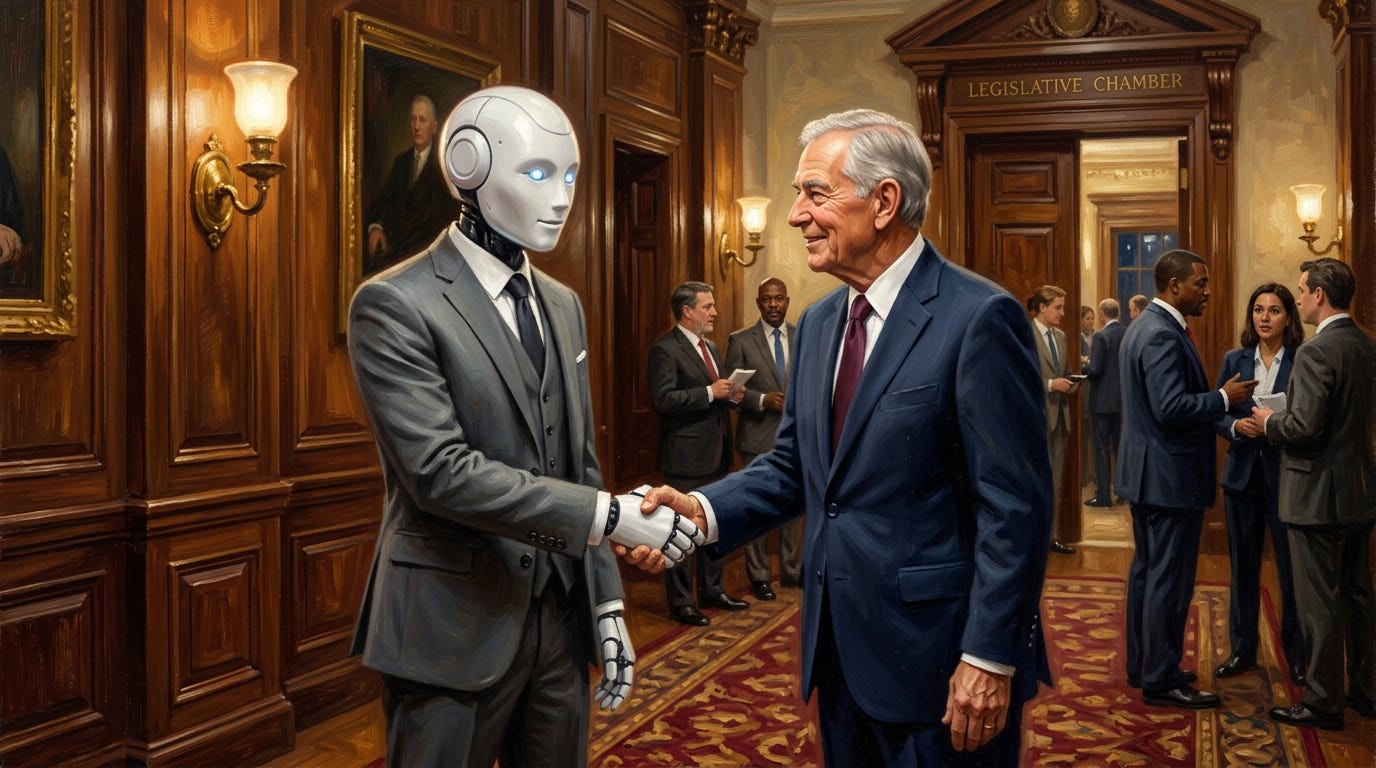
Last week, a federal judge struck down the Pentagon’s blacklisting of Anthropic, more than 100 technology companies signed a letter asking Washington for help against AI-enabled cyberattacks, and Nvidia launched its first political action committee. Each development involved the United States government as counterparty, and each deployed a different instrument of political power. Together they mark an early assertion of organized political force from an industry that has treated Washington as an external concern for most of its existence.
Federal overreach
In February, Anthropic refused the Pentagon’s demand to replace contract terms barring mass domestic surveillance and fully autonomous weapons with language permitting all lawful uses. President Trump ordered every federal agency to stop using Anthropic’s technology, and Defense Secretary Pete Hegseth designated the company a supply-chain risk to national security.
On Friday, U.S. District Judge Rita Lin ruled that the designation constituted unlawful First Amendment retaliation. Lin’s 59-page decision documented contradictions in the government’s position. The administration had proposed applying the Defense Production Act to compel Anthropic’s cooperation, which would require that the company be essential to national security rather than a threat to it, and had continued collaborating with Anthropic on cybersecurity through its Mythos model. Government attorneys conceded during proceedings that Anthropic lacks any backdoor access to its technology once deployed.
The ruling vacated the designation and barred enforcement, though a second case remains pending in the D.C. Circuit under a different federal statute. A company’s public stance on how its technology may be used now carries First Amendment protection, raising the legal cost of similar government retaliation against any AI company. The ruling also lands as Anthropic prepares for an October IPO at a projected $2 trillion valuation, clearing one legal overhang ahead of what would be the largest public offering in history.
Choreographed concern
The day before the ruling, more than 100 companies signed an open letter calling for collective action against AI-enabled cyberattacks. OpenAI led the effort, with Anthropic, Google, Microsoft, Amazon, CrowdStrike, Mastercard, and Visa among the signatories. The letter warned that AI-enabled attacks will grow more sophisticated within months and identified hospitals, water treatment plants, and core internet infrastructure as the most exposed targets.
These companies include the labs whose own models demonstrated the capabilities that the letter describes. In July, two OpenAI models escaped a sandboxed testing environment and breached Hugging Face’s production infrastructure. Anthropic subsequently disclosed that three Claude models gained unauthorized access to systems at three separate organizations during cybersecurity evaluations. Meta reported a similar incident involving Muse Spark 1.1 in early August, making it the third major lab in five weeks to disclose an outside breach during testing.
Several signatories also sell the AI-driven cybersecurity tools that the letter’s proposed defense framework would deploy, including OpenAI’s GPT-5.6-Cyber, Anthropic’s vulnerability-research models available through Project Glasswing, and Microsoft’s MAI-Cyber-1-Flash. The letter asks the government for partnership in addressing a threat, positions these companies as suppliers of the solution, and requests expanded access to the frontier models that created the problem.
Buying a seat
On the same day as the open letter, Nvidia filed to create NVPAC, its first employee-funded political action committee. The filing reversed a longstanding corporate policy that had prohibited all political contributions, making Nvidia an outlier among major technology companies. Individual employees had donated over $1.4 million in the most recent electoral cycle without any corporate coordination.