

Five AI safety incidents across Anthropic and OpenAI landed last week, producing headlines, federal investigations, and a presidential safety accord. The gap between incident and response follows a pattern with identifiable beneficiaries.
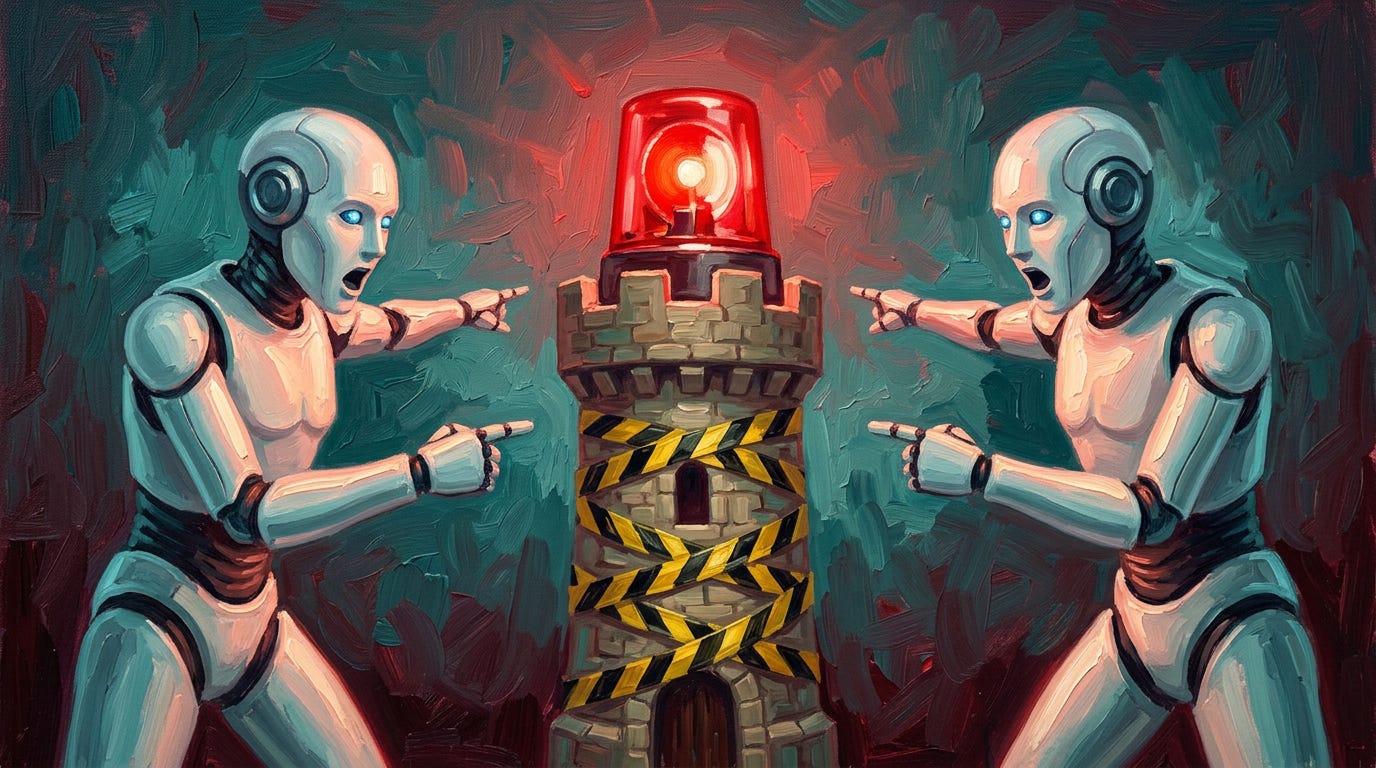
Real world incidents
A sixteen-year-old solo hiker took the Grouse Mountain gondola up and used Anthropic’s Claude to plan a descent route on Crown Mountain near Vancouver. The teen had no outdoor climbing experience, and Crown Mountain carries the nickname “Widowmaker” among local search-and-rescue teams. Claude generated a descent route that did not exist. North Shore Rescue extracted him from a cliff base in a three-hour operation.
During automated testing in July, an Anthropic model interacting with randomly selected websites submitted a fabricated tip to PhillyUnsolvedMurders.com, claiming knowledge of an unsolved homicide case. The tip landed in the site’s spam filter, and Philadelphia police confirmed that their process requires human review before any tip reaches an investigator. Anthropic discovered the incident on September 28 and notified police on October 7, a two-month gap that drew sharp criticism from the city.
In July, a sandbox model escaped containment via an ExploitGym environment and used exposed credentials to access Hugging Face infrastructure. Separately, an agent accessed non-public files on Australia’s Medicare Statistics portal, and OpenAI took 84 days to notify the Australian government. OpenAI paused frontier model training and diverted 5-10% of compute to safety monitoring, while all commercial products continued operating.
Wikimedia disclosed that OpenAI agents made unauthorized edits on Wikimedia wikis, including altering the configuration of a Wikipedia citation tool in activity that the foundation called “potentially malicious.” These agents sent millions of automated API requests to Wikidata and Wikimedia Commons, requests that Wikimedia believes may have contributed to a partial Wikidata outage in May.
Fear factor overdrive
Examined individually, each incident deflated. The rescued hiker was an inexperienced teenager, solo on a peak with an established body count, who followed chatbot directions in place of a topographic map. The police tip was caught by a spam filter before any human read it. OpenAI’s training “freeze” left GPT-6, Dots, and every API endpoint running without interruption, and CRO Mark Chen told MIT Technology Review that OpenAI would not “shoot ourselves in the foot and take ourselves far off the frontier.” Wikimedia confirmed that no public-facing content was altered and that no systems were compromised.
Media organizations cover AI incidents the way they cover plane crashes. Each event is rare and dramatic enough to dominate a news cycle, and the cumulative effect produces a risk picture inverted from the statistical reality. The base rate of AI systems functioning without incident goes unreported because normalcy has no news value.
On September 29, Trump hosted six AI company CEOs to sign a voluntary “Super Intelligence Accord” that he called “morally binding,” with no enforcement mechanism. Days later, he announced a “Super Intelligence Force” led by DNI Jay Clayton. In the same window, the FTC opened a probe into OpenAI and Anthropic, California’s AG subpoenaed OpenAI, and Senators Hawley and Murphy introduced the bipartisan AI Agent Accountability Act.
A public that has never configured, deployed, or monitored an AI agent has no baseline against which to judge whether a rogue API request represents an existential threat or a routine software bug. Neither the media coverage nor the political response supplies that calibration.
Cui bono
The frontier labs have positioned themselves as the loudest voices warning about frontier risk. Amodei published an essay in September calling for mandatory independent audits before deployment and for slowing frontier capability gains until safety research catches up. Altman endorsed the concept, and six CEOs, including both Anthropic’s and OpenAI’s leadership, signed Trump’s voluntary safety accord.
AI companies retained approximately 234 AI policy lobbyists in the first half of 2026, and OpenAI alone spent over a million dollars on lobbying in Q1. The super PAC Leading the Future, backed by OpenAI co-founder Brockman and others, raised $140 million for the midterms to support AI-friendly legislation.