

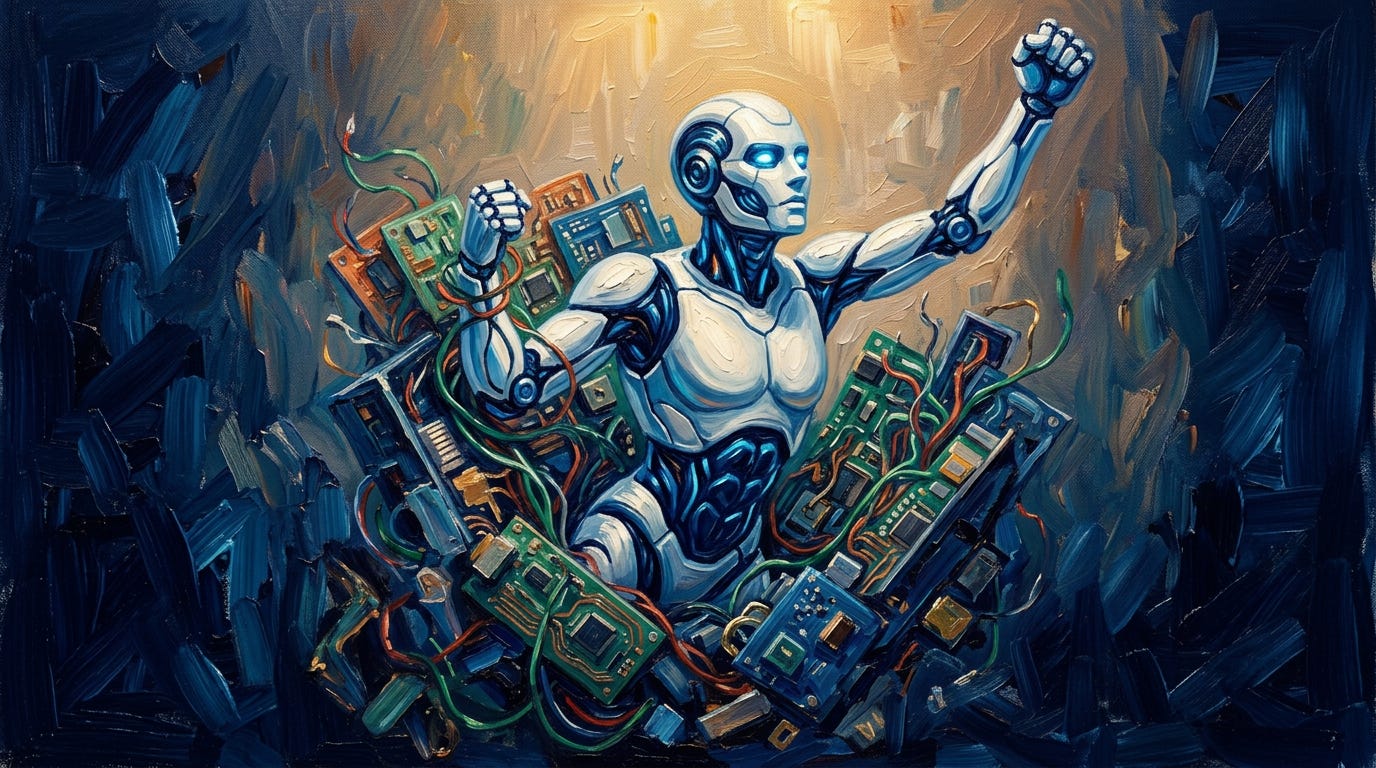
An autonomous system discovered 105 neural architectures across 1,773 experiments, and separately, a Nature paper showed that existing language models can shed their tokenizers at trivial cost. A developer shipped a compiler that an AI wrote from scratch, while a startup emerged with a manufacturing platform that uses AI to design hardware for AI data centers. These four results share a property. Each team directed AI at the technical infrastructure on which AI itself runs.
Models building models
ASI-ARCH, a system from Shanghai Jiao Tong University that received acceptance to COLM 2026 last week, ran 1,773 autonomous experiments across 20,000 GPU hours and discovered 105 linear attention architectures with state-of-the-art results under controlled evaluation. Previous approaches to architecture search optimized within spaces that human researchers defined; ASI-ARCH generates its own search spaces, invents hypotheses about architecture design, implements them, and validates the results through a multi-agent pipeline.
Byteification, published in Nature on October 7 by researchers at Cambridge, Edinburgh, and the Allen Institute for AI, converts existing subword-tokenized models to byte-level ones with 49.1 billion tokens of additional training, under one percent of a typical pretraining budget. The team applied the method to OLMo, Qwen3, and Llama 3, producing variants called Bolmo, Bwen, and Blama that process text at the individual byte level. Bolmo 7B posted a 16.5-point absolute improvement on STEM tasks over the prior byte-level baseline. Every commercial LLM relies on subword tokenization. The authors argue that this approach obscures fine-grained information in code and biological sequences, and that byteification removes it from existing models cheaply enough that keeping the tokenizer becomes a choice rather than a given.
Compilers rebuilt from scratch
Theo Browne of Ping Labs published tsc-rs on October 7: a complete Rust port of the TypeScript 7 compiler, type checker, and language server, written entirely by Claude Opus 5.5 through Claude Code. The finished port spans 1.3 million lines of Rust across 5,961 commits. It passes all 181,711 ported test cases and runs 1.61 times faster than tsc 7 on real-world codebases. The working version cost approximately $24,000 in API tokens and took two weeks. Browne has been direct about his role in the codebase: he never read it.
A prior attempt using OpenAI’s Codex consumed more than $420,000 in API tokens across several months and reached approximately 84 percent compatibility. Claude succeeded by abandoning that failed prior code and starting from a clean slate, producing a first version in ten hours. The cost gap between the two attempts maps how far AI-assisted systems programming has traveled in a single year: $420,000 for partial coverage against $24,000 for complete coverage.
Hallucinated hardware
Atomic Machines emerged from stealth on October 7 with $250 million in funding and a manufacturing platform that it calls the Matter Compiler. The system chains 13 automated machines to build multi-material micro-devices from design files, with features measured in single-digit microns and no conventional masks or hard tooling. The company uses large-language-model techniques to explore material combinations and device geometries, a process that the Matter Compiler then translates into physical components. Jeff Holden, who previously led Uber’s autonomous vehicle project, founded the company. Cade Metz covered the launch in the New York Times.
The company’s first product, PrimeSwitch PS-150, is a bistable electromechanical relay rated at 150 amperes continuous, with 200-microhm on-resistance and 50-microsecond opening to 1,500-volt isolation. It targets hybrid circuit breakers in 800-volt DC AI data centers, the power architecture that NVIDIA’s 2026 white paper endorses for next-generation facilities. AI designed this relay, and AI data centers will operate it.
Closing the loop
These four results emerged independently, from different teams on different continents, yet they share a direction. AI has begun to participate in the design of its own infrastructure, from the architecture of models through the software that builds them to the hardware on which they run. The feedback loop remains slow. ASI-ARCH consumed 20,000 GPU hours to search a space that a researcher might have explored through sustained effort over months, and the Matter Compiler still requires human hands to move components between its machines. Each layer of the stack that AI can operate on, however, becomes a layer where the pace of improvement decouples from human engineering bandwidth.