

October has been an unusually revealing month for AI hardware. Nvidia shipped containerized data centers while AMD published an open rack blueprint that dispenses with GPUs entirely. A RISC-V chip startup more than doubled its valuation on the strength of alternative silicon. A Chinese lab, meanwhile, trained a trillion-parameter model without touching the Western supply chain. Each of these developments reflects a different theory of what AI compute requires. The GPU shortage that dominated 2024 and 2025 created demand for alternatives, and October’s announcements reveal how far that search has progressed.
The data center in a box
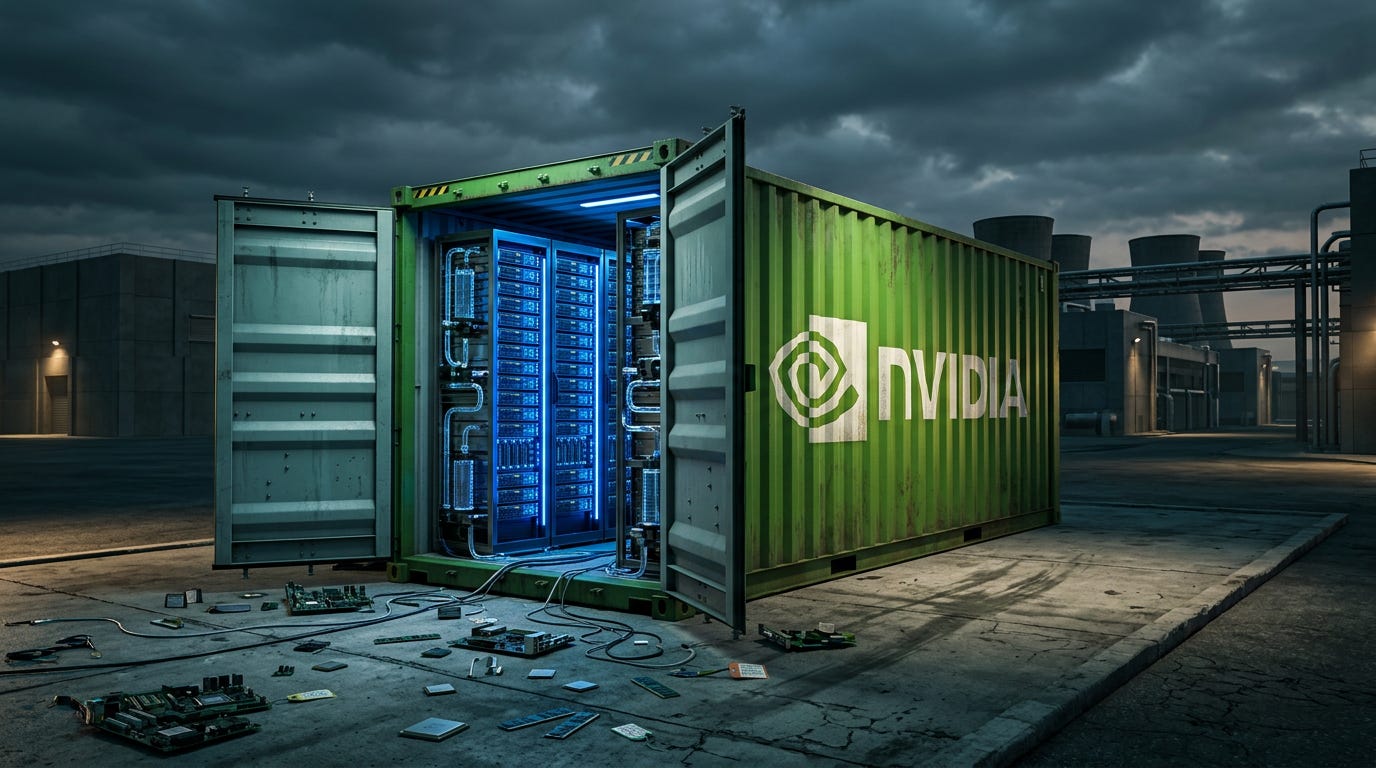
At GTC Berlin last week, Nvidia unveiled DSX POD, a reference design that packages seven Vera Rubin NVL72 racks inside a shipping container. Each container holds 504 Rubin GPUs alongside networking, cabling, and liquid cooling, all pre-assembled and factory-tested before shipment. Nvidia claims that this approach reduces site deployment from roughly six months to fourteen days. Seventeen partners, including Dell, HPE, and Schneider Electric, plan to ship these containerized AI factories worldwide in early 2027, with analysts estimating that each Vera Rubin rack may cost upward of seven million dollars.
DSX POD rests on Vera Rubin, Nvidia’s third-generation rack-scale architecture. The core unit, the NVL72, pairs 72 Rubin GPUs with 36 Vera CPUs and delivers 3.6 exaflops of FP4 inference per rack, roughly 3.3 times the Blackwell generation’s output. Dedicated companion systems handle agentic orchestration, low-latency inference, AI-native storage, and rack-to-rack networking. This five-system design reflects Nvidia’s assessment that AI workloads have diversified beyond model training into categories with distinct hardware requirements. Each rack draws 190 to 230 kilowatts and requires liquid cooling, up from roughly 40 kilowatts for an air-cooled Hopper-generation rack two years ago. Over successive product generations, Nvidia’s unit of sale has moved from a chip to a server to a rack to a factory-assembled building.
Challengers across the board
AMD introduced Helion at the Open Compute Project Global Summit earlier this month, an open rack blueprint for agentic AI workloads. Helion builds on AMD’s existing Helios solution for training and inference, extending the company’s open-platform approach into a workload category it treats as architecturally distinct. The design supports CPU-only configurations with up to 32,768 Zen 6 EPYC cores, or mixed setups combining EPYC processors with Instinct MI350P GPUs. AMD argues that many agentic workloads, from personal assistants to enterprise applications to code execution, need CPU density more than GPU acceleration. The company plans to contribute the Helion specification to the Open Compute Project, with partner rack configurations expected in November.
Tenstorrent closed a $1.5 billion Series E last week at a $6.2 billion post-money valuation, more than doubling its December 2024 mark. The Toronto-founded company, led by veteran chip architect Jim Keller, builds RISC-V AI processors rather than GPUs. RISC-V is an open instruction set with no licensing dependency on any single CPU vendor. Tenstorrent’s Galaxy Blackhole servers reached general availability in April, packing 32 Blackhole chips into a single server delivering roughly 23 petaflops of AI compute. The round drew Fidelity, ARK Invest, Morgan Stanley, and SanDisk, though no customers have been publicly named. At $6.2 billion, the valuation prices a bet on the category rather than a proven order book.
As more accelerator families reach production, data centers will run mixed silicon. Upscale AI, backed by Nvidia, announced Token Fabric, a networking platform that connects processors from different vendors within the same facility. The first components ship in Q4 2026.
The parallel supply chain
A Chinese laboratory completed pretraining of a 1.6-trillion-parameter model on approximately fifty thousand domestically manufactured accelerators, with no Nvidia silicon anywhere in the training run. Architecture details and independent benchmarks remain unpublished, but the run establishes that frontier-scale pretraining can proceed on hardware the Western supply chain does not touch. ASML and TSMC have both warned that AI silicon demand exceeds global supply through at least 2028, and a credible non-Western path to frontier training reshapes the commercial calculus for every buyer in the market.
The vertical advantage
Open rack blueprints, RISC-V inference silicon, and non-Western frontier training all exist as genuine technical paths that were absent at this scale two years ago. AMD Helion configurations ship in November, Tenstorrent has raised $6.2 billion without naming a customer, and China’s trillion-parameter training run lacks independent benchmarks. Nvidia has seventeen partners manufacturing containerized Vera Rubin factories for delivery in early 2027. The supply constraints that ASML and TSMC have warned of may eventually push buyers toward second sources, turning architectural experiments into production-scale alternatives. For now, the AI compute landscape has fractured along commercial, architectural, and geopolitical lines, and the company that ships complete systems continues to set the pace.