

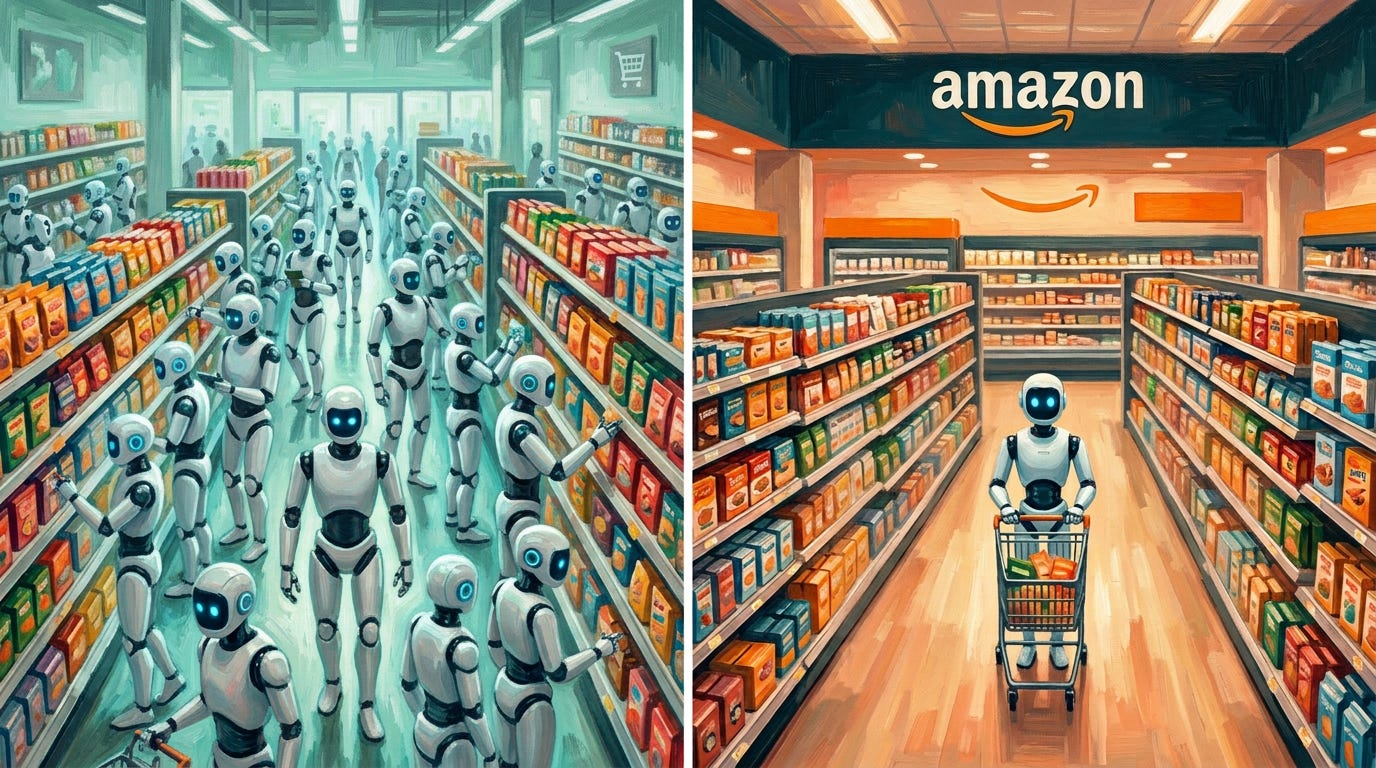
The infrastructure for AI agent commerce materialized in months. Four competing protocols launched between May and October. Walmart built an MCP server that lets agents shop its inventory. Shopify extended its checkout tools to handle agent-driven purchases. Amazon has blocked every major external agent from its platform while operating its own agents on competitors’ sites.
Welcoming the machines
Walmart CEO John Furner announced the Walmart Agent Gateway at the Masters of Scale Summit on October 21, a server built on Anthropic’s Model Context Protocol that gives approved agents from ChatGPT, Gemini, and Muse structured access to Walmart and Sam’s Club inventory and checkout. Customers need not share personal information or purchase history with the agent directly; the Gateway mediates the connection. Agent Profiles, rolling out next month, let customers authorize each agent with a dedicated profile, set spending caps or require per-transaction approval, and track agent purchases separately from their own. The Gateway’s terms specify that agents cannot take actions beyond the shopper’s intent, cannot access payment information, and Walmart’s returns policy covers agent-initiated purchases, including cases where an agent fails to act as intended.
Shopify extended WebMCP to checkout in September, adding structured tools that let agents read checkout state, update fields, and submit orders. The buyer must still confirm the total and authorize submission on the page before any purchase completes. AI-driven new orders on the platform grew nearly 200% year over year, against roughly 12% growth for traditional organic search, providing an early measure of what agent-accessible retail captures.
Sierra and Meta published the Personal Agent Protocol on October 6, an OAuth-based open standard with 35 design partners including Walmart, Shopify, Stripe, Visa, Mastercard, and PayPal. Under the protocol, a personal agent authenticates with a business through OAuth, and the business defines what that agent can access. A v0.1 specification is due later this month. Visa launched its Trusted Agent Protocol in June, claiming coverage of approximately 175 million merchants, while Google introduced the Universal Commerce Protocol and Agent Payments Protocol at I/O, and Mastercard shipped Agent Pay. The industry produced four competing standards for agent commerce in under five months.
Privileging Alexa
Amazon began blocking Meta’s Muse from its platform on September 20, displaying warnings that continued access by an unauthorized AI agent violates its conditions of use. The company has since expanded those restrictions to agents from ChatGPT, Claude, Gemini, and Perplexity, and sued Perplexity over its Comet shopping agent in November 2025. Amazon won a preliminary injunction against Perplexity in March, but the Ninth Circuit vacated it in August, ruling that Amazon had failed to show that the agent, rather than the user, accessed its systems. That ruling undercut Amazon’s core legal argument: that an AI agent’s activity constitutes unauthorized computer access under federal law.
Amazon builds its own shopping agents through Alexa, which can add items to carts and complete purchases on other retailers’ sites. Amazon’s agents reach every retailer’s inventory. Competitors’ agents reach everyone except Amazon.
Compounding commitments
Stripe appears in the partner lists of both Sierra’s Personal Agent Protocol and Visa’s Trusted Agent Protocol, positioning itself as payment infrastructure that functions regardless of which standard prevails. Shopify has built checkout tools for both server-side MCP and browser-based WebMCP. The payment and commerce layers have committed to agent commerce as a retail channel, and these commitments carry the weight of real integrations.
Each protocol defines its own authentication, payment, and session models, and the integrations that developers build against these standards create network effects. Every agent connection built against Walmart’s Gateway or Shopify’s checkout routes purchasing activity through platforms where agents can operate. The longer Amazon excludes itself from this infrastructure, the more purchasing activity flows through its competitors.
The costs of changing course
Amazon’s marketplace remains the largest in American retail. Its blocking strategy is a wager that controlling the customer relationship outweighs the cost of being the one major destination that agents cannot reach. The rest of the industry has placed a different bet, and the infrastructure behind that bet accumulates quickly. Walmart ships Agent Profiles next month, the Personal Agent Protocol’s v0.1 specification lands this month, and Shopify’s checkout tools are already live. Amazon’s window to reverse course without significant cost narrows with each new integration.