

DeepSeek shipped two model releases, an open-source agent framework, a pricing overhaul, and a robotics investment in August. Together, those releases assembled the same full-stack infrastructure that OpenAI and Anthropic have spent years building. The most architecturally significant received the least coverage: an MIT-licensed agent runtime called DeepSeek Harness, which went live on August 13 alongside the V4-Pro flagship. The Harness places DeepSeek in the developer tooling layer alongside Claude Code and Codex, a market that no Chinese AI company had entered.
Everything is a plugin
DeepSeek open-sourced the Harness on August 13, the same day it shipped V4-Pro to general availability. The runtime targets the same category of work that Claude Code and OpenAI’s Codex occupy: autonomous coding and multi-step tool use from a terminal or browser. The Harness put DeepSeek into a developer tooling competition that American labs had until then defined.
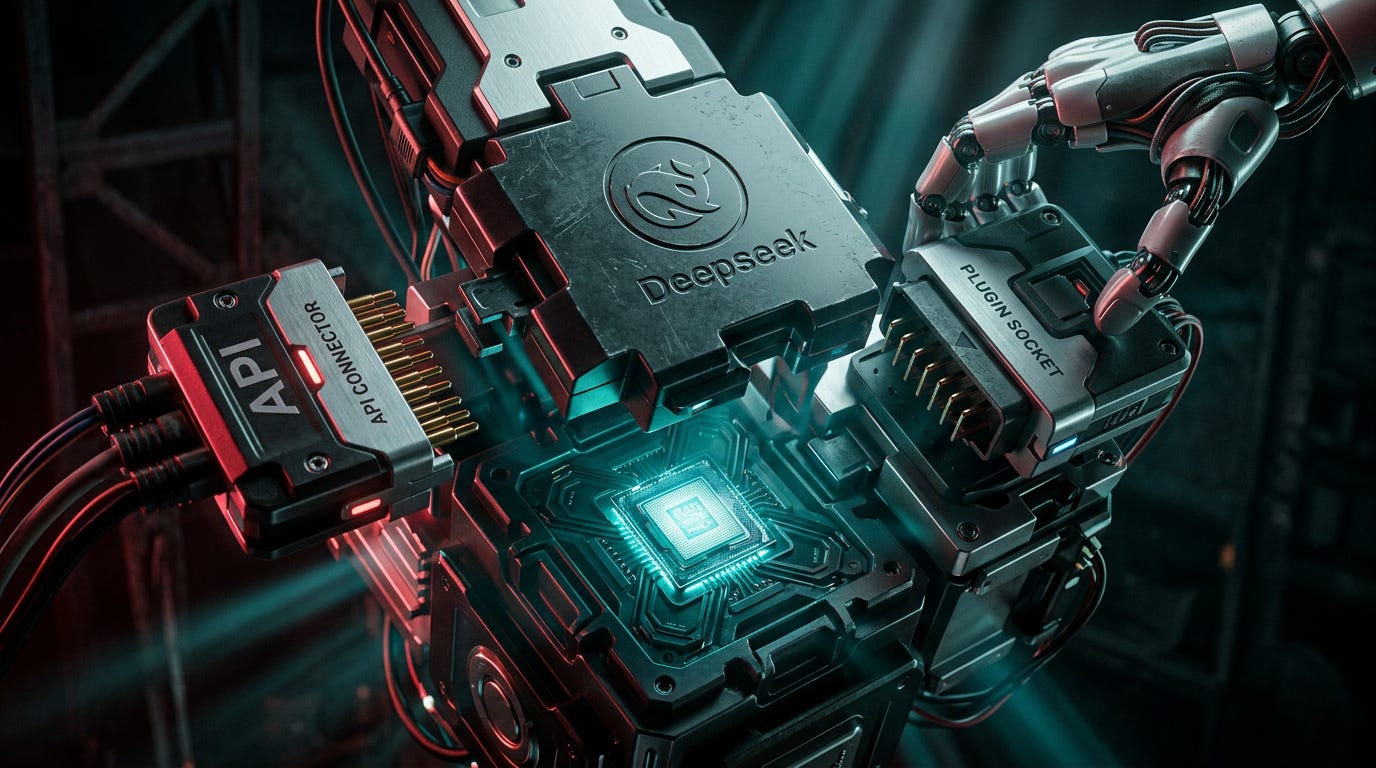
The Harness runs on a micro-kernel called Cordis, in which every functional unit operates as an isolated plugin: model adapters, tool registries, sandboxes, session handlers, and the agent loop itself. The architecture privileges no single component. A developer can replace the model, the execution environment, or the orchestration logic without modifying the rest of the stack. The Harness is model-agnostic by design: it ships with a DeepSeek adapter, but developers can connect any OpenAI-compatible endpoint, including models from Anthropic or a self-hosted open-weights deployment. The runtime records every run in an append-only session log, making each execution replayable and forkable.
The runtime had already served as DeepSeek’s internal benchmark infrastructure. The V4-Flash agent scores published in July credited the Harness’s “minimal mode” as their evaluation framework. When the repository went public, it collected 155,000 GitHub stars in five days and attracted more than 7,000 community plugins within a week. That pace suggests that the modular approach resonated with developers already working inside more rigid alternatives.
The summer sprint
The Harness arrived as one component of a compressed product sequence. V4-Flash had shipped with open weights under MIT on July 31: a 284-billion-parameter mixture-of-experts model that activates only 13 billion parameters per token. Post-training had pushed its agent benchmark scores past the V4-Pro preview, and DeepSeek promoted the smaller model as its default agent engine while the flagship continued development. V4-Pro reached general availability on August 13 as a 1.6-trillion-parameter model with a one-million-token context window, MIT-licensed weights on Hugging Face, and native support for the OpenAI Responses API format.
Three days after the Pro launch, DeepSeek restructured its API pricing. Output tokens for V4-Flash rose from $0.28 to $1.32 per million at peak hours, and V4-Pro peak output reached $3.96 per million. Off-peak rates, available during seventeen of the day’s twenty-four hours, run at half the peak price. The company that had built its reputation on ultra-cheap inference began extracting revenue from the position that strategy had secured.
On August 6, DeepSeek invested $21 million in Unitree Robotics’ Shanghai STAR Market IPO and signed a three-year partnership to co-develop AI models for humanoid robots. Unitree, which controls roughly 31 percent of global humanoid shipments, supplies the hardware and the physical-world training data that language models cannot generate. DeepSeek provides the model infrastructure. The deal extends DeepSeek’s reach into embodied intelligence, a domain where the scarce input is real-world sensor data rather than text scraped from the internet.
Race to the frontier
Eighteen months ago, DeepSeek was a research lab with a chat interface, an API, and a model release that had rattled semiconductor valuations. The current inventory spans frontier-class models in two tiers, MIT-licensed open weights for both, a modular agent runtime with a plugin ecosystem that outpaced all predecessors in its first week, a hardware partnership with China’s leading humanoid manufacturer, dynamic API pricing, and preparations for a mainland IPO at a $74 billion valuation. OpenAI and Anthropic assembled comparable platforms over years of venture rounds, enterprise sales organizations, and cloud-provider partnerships.
DeepSeek reached a comparable position in months, from Hangzhou, funded initially by a quantitative hedge fund’s balance sheet. The company’s first external funding round closed in June at $52 billion; by August it had resumed raising at $74 billion, a repricing that reflected the platform trajectory rather than model benchmarks alone. The AI competition between the United States and China now has two full-stack entrants, and the second one arrived faster than most of the industry had forecast.
An alternative platform
DeepSeek has spent August converting itself from a model vendor into a platform company. The Harness, the open weights, the pricing restructure, and the Unitree partnership each filled a layer of the stack that the company lacked at the start of the summer. Running frontier models, developer tooling, an open-source ecosystem, a hardware partnership, and a public listing simultaneously demands sustained organizational capacity that few companies of any nationality have demonstrated. Building the models proved to be the less demanding half of the challenge, and sustaining a platform around them will test whether DeepSeek’s engineering velocity translates into operational durability.