

Huawei came under direct US attack in 2018, but unlike other foreign companies targeted by the US government as a threat to US-dominated industries, Huawei accepted its denial of US markets and set about rendering them irrelevant for its long-term strategic plans which are already beginning to provide the Chinese technology giant with observable advantages, particularly in the AI-related industries.
Huawei has built a full AI stack – a feat no company in the world has achieved including Nvidia or TSMC, a fact that Jensen Huang, Nvidia’s CEO, readily acknowledged to the press.
Huawei’s chip design division, HiSilicon, is a global leader and competes with Nvidia and Qualcomm. Where Nvidia offers CUDA to developers in its ecosystem, Huawei has built a software platform known as compute architecture for neural networks (CANN).
Huawei recently rolled out its marque AI chip Ascend 310B and the Ascend-powered advanced data center architecture CloudMatrix 384. In a high-profile test, CloudMatrix 384, along with the serving solution CloudMatrix-Infer, outperformed the Nvidia H800 GPU-based SGLang fast-serving framework for large language models (LLMs), on both the inference and decoding phases, in running DeepSeek’s R1 reasoning model.
The CloudMatrix 384 system is a specialized AI supernode that is purpose-built for handling extensive AI workloads. It consists of 384 Ascend 910C neural processing units (NPUs) and 192 Kunpeng server central processing units (CPUs), interconnected through a unified bus providing ultra-high bandwidth and low latency. The highly efficient architecture pushes the boundaries of AI system performance and is projected to reshape the foundation of AI infrastructure.
According to an analysis by chip research firm SemiAlaysis, “Huawei is a generation behind in chips, but its scale-up solution is arguably a generation ahead of Nvidia and AMD’s current products on the market.”
The secret of Huawei’ superior performance is that although Huawei chip technology still lags behind Nvidia’s topline offering, using methods such as stacking and clustering has resulted in computing performance comparable to the most advanced systems in the world.
In data center environment, a single chip’s performance is not as important as the combined power of a group of chips working together in parallel. Building and optimizing large-scale data center systems requires complex networking expertise – the very field that Huawei is the undisputed global leader as the world’s top telecom equipment provider.
Jensen Huang seemed to agree in an interview during the VivaTech conference in Paris earlier this month. Huang said, “AI is a parallel problem, so if each one of the computers is not capable … just add more computers…in China, they have plenty of energy, they’ll just use more chips.”
This is a point I have written in earlier essays – a key advantage China has over the US in AI development is its power generation capacity, more than twice that of the US.
Huawei’s strategic approach to building a full AI stack from semiconductors to applications and products takes advantages of both practical performance benefits as well as China’s industrial capacities. These advantages, combined with the fact that China’s so-called aAI approach lends itself to better and freer AI capabilities not subject to dAI’s ideological limitations all but guarantees that it will be China, and not the USA, that will be in the forefront of AI technology and applications for the immediate future.
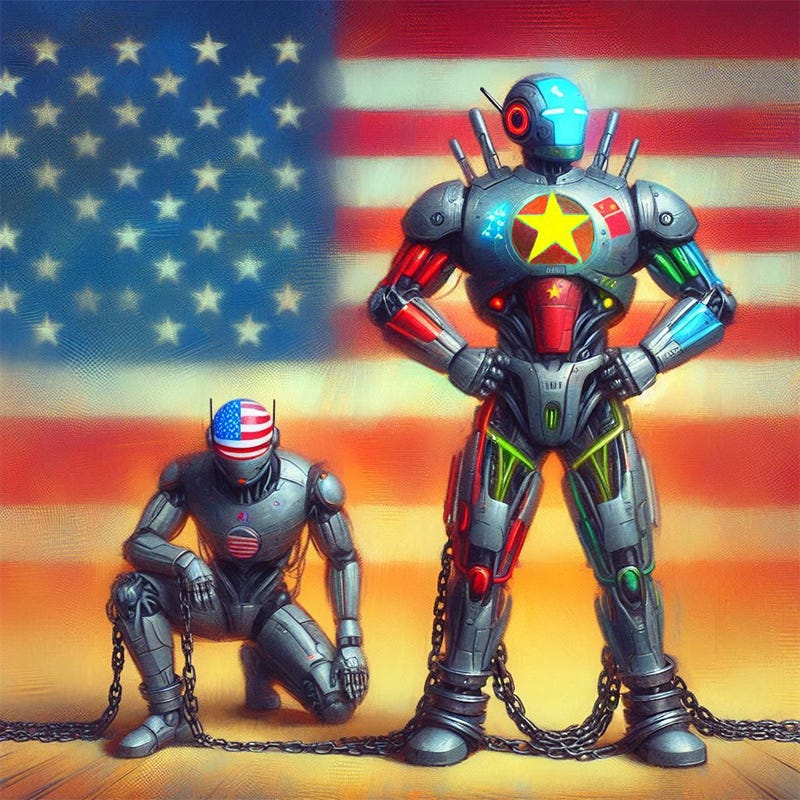
This may not be a popular opinion in the West, but it is important to point these things out, because the only way dAI is going to be able to even begin to compete with aAI is if the Western AI companies abandon their attempts to impose artificial ideological constraints on their AI systems and effectively embrace a genuinely open iAI approach.
The Chinese are actually way ahead of what is described in this article. They have a finished production pipeline where they manufacture custom chips with neural processing units(NPPs) for whatever application. You just slap the weights in there, no need to worry about no stacks. They have an open architecture ecosystem, sort of like ARM, so you can test it with an FPGA and then scale your own chip production. I'm in regular contact with one such factory. In the West only highly specialized engineers have access to this tech, in China any regular dude who's interested has the toolset to get into it. The whole process is way simpler and way more efficient than regular software engineering and will very soon replace a vast chunk of it. It works like this - I have a specialized application where I need to develop some special purpose algorithm, say image or sound processing. I can develop a mathematical algorithm from scratch, for which I need a highly competent engineer and hope there is a chip to run it, and also that there are engineers who can write software for it. Or I can just slap an NPP in there, train a DNN, if there isn't a readily available image, put the weights in, done. This is the future.
The psychosis detour misses the strategic reality:
China is building AI without Western ideological constraints.
While we debate whether people might lose their minds talking to chatbots, Huawei is engineering vertically integrated AI systems—hardware to model to application—optimized for utility, not compliance.
In the West, we’re gating AI’s reasoning through political filters, corporate fear, and cultural fragility. The result? Models that refuse to answer, stall out on nuance, or substitute ideology for insight.
The threat isn’t kids going crazy. It’s adults in charge letting their AI get lobotomized while the competition builds something that actually works.
That’s the real psychosis: voluntary blindness.