

The Lyrid meteor shower, observed for at least 2,500 years, peaked on the night of April 21–22 under a dark sky free of moonlight. It drew the usual crowd of stargazers out into backyards and along rural highways. Most of them still do what amateur astronomers have always done: find a chair, look up, wait. The equipment itself has changed, and so has the work it does once pointed at the sky.
Point and look
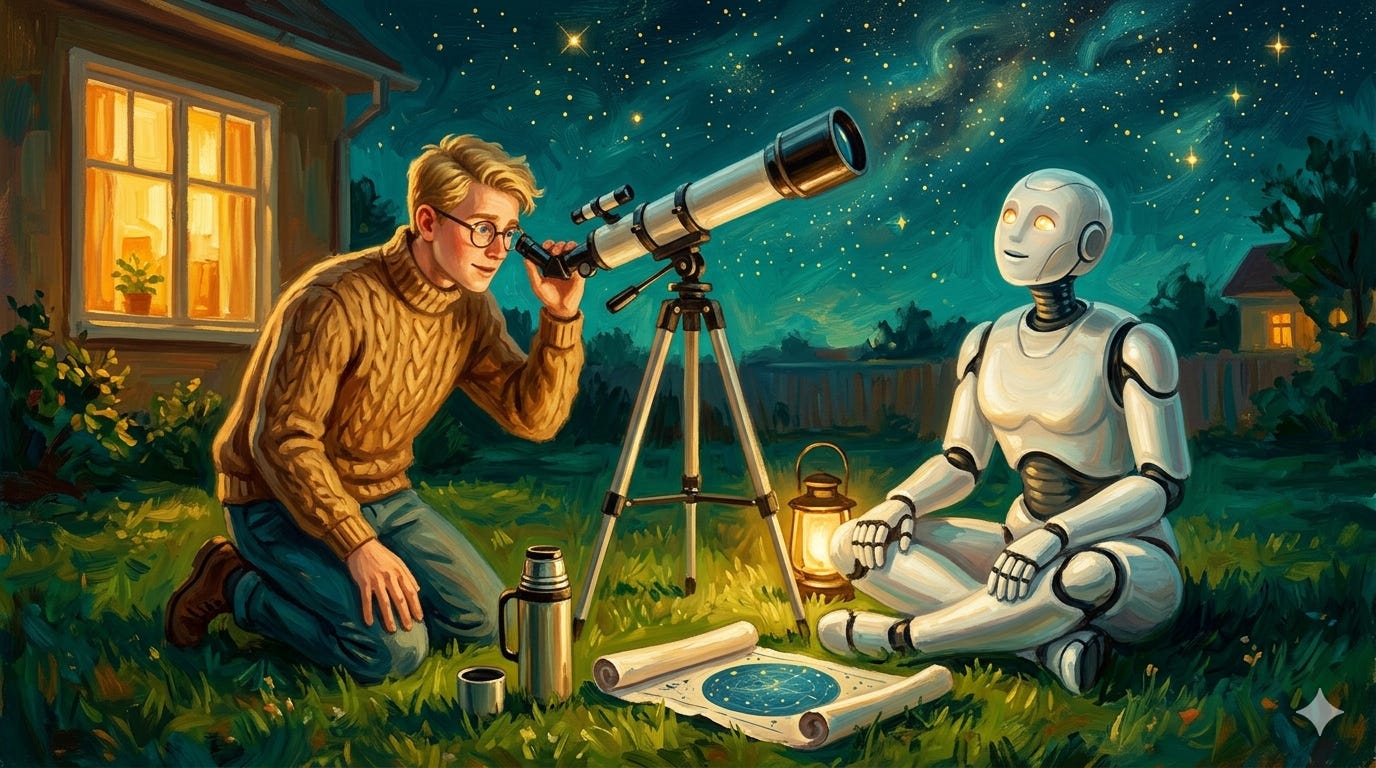
Smart telescopes now occupy a real product category with internal tiers. At the entry level, the ZWO Seestar S30 retails for about $349 and DwarfLab’s Dwarf Mini lands at roughly the same price, each small enough to sit on a café table and ready to image within minutes of unboxing. The high end runs through Vaonis’s Vespera Pro and on to the $4,000 Celestron Origin Mark II, a home-observatory system whose Sony Starvis 2 sensor and onboard autoguider handle the full imaging chain in a single enclosure. Philosophy separates these tiers as much as optics does. Budget scopes are portable imagers built for a backpack, while premium systems sit in a yard and run observing programs all night.
Across all of these, AI handles the setup work that gated amateur astronomy for decades. The scope points itself by matching the star field against a catalog, a technique called plate solving. It tracks the target to compensate for Earth’s rotation, stacks hundreds of short exposures to build a deep-sky image, and applies light-pollution filtering so a suburban yard works nearly as well as a rural field. Unistellar’s Enhanced Vision and Vaonis’s Singularity app process these steps on the scope itself, so the image appears on a phone in seconds rather than requiring hours of later work on a PC.
On a conventional amateur setup, the first year goes to learning collimation, polar alignment, and manual star-hopping. Smart telescopes bypass that work entirely. The observer decides where to point the scope, and the entry fee to the hobby has moved from mastering the instrument to choosing the target.
The data avalanche
These smart telescopes feed networks that have turned the hobby into a research instrument. The Unistellar–SETI Institute partnership draws on a community of roughly 2,500 active observers who coordinate via Slack. They submitted more than 15,000 observations in 2025, a 50% increase over the year before. The Unistellar app pushes alerts for asteroid occultations, exoplanet transits, comet outbursts, and supernova candidates, and anyone with a compatible scope can opt into the campaigns those events trigger.
The results show up in peer-reviewed science. When NASA’s DART spacecraft struck the asteroid Dimorphos in September 2022, Unistellar observers on Reunion Island and in Kenya captured the impact, the debris plume, and the brightening that followed, contributing data that made it into the resulting Nature paper. In 2025, a study led by the University of New Mexico’s Dr. Zarah Essack confirmed the exoplanet TOI-4465 b, a Jupiter-sized world roughly 400 light-years out, using data contributed by 24 observers across 7 countries. Citizen astronomers appear as co-authors on that paper and on a growing list of others.
SkyMapper is SETI’s larger-scale follow-on, an AI-coordinated telescope network that aims to reach roughly 1,000 nodes by the end of 2026, each capable of monitoring any region of the sky in near real time. Observations carry cryptographic verification through an Avalanche-based layer called SkyMapper L1, so they arrive with the kind of provenance that academic research demands. Through that infrastructure, a backyard telescope contributes to the same data stream as professional observatories.
A pastime expanded
The Eta Aquariid meteor shower, debris from Halley’s Comet, peaks in early May. That kind of event draws amateurs out with or without a smart scope. Exoplanet transits and asteroid occultations appear on the calendar every clear night, along with occasional rare targets like the interstellar comet 3I/ATLAS that citizen astronomers tracked through 2025. The scope sits in the yard, and the work it does counts as both a hobby and a contribution to science.
I need to invest in one of these. It's difficult to align and focus manually my old dusty scope while trying to follow the sky.