

A few months ago, when I was just discovering that textual AI had made a great leap forward not dissimilar to the one made in music with Suno 3.0, I did an interesting test to see how well AI could imitate a given author’s literary style. These were done with an earlier version of Claude, specifically, Sonnet 3.7. Exactly the same prompt was given, with the only distinction being the instruction to write the short story in the style of the given author.
See how many of the authors of the ten short pieces below you can guess correctly. If you are a VP reader and you already know the answers, don’t say anything, leave it to those who are new to this to share their opinions.
THE LIBRARIAN OF FORGOTTEN SUNDAYS
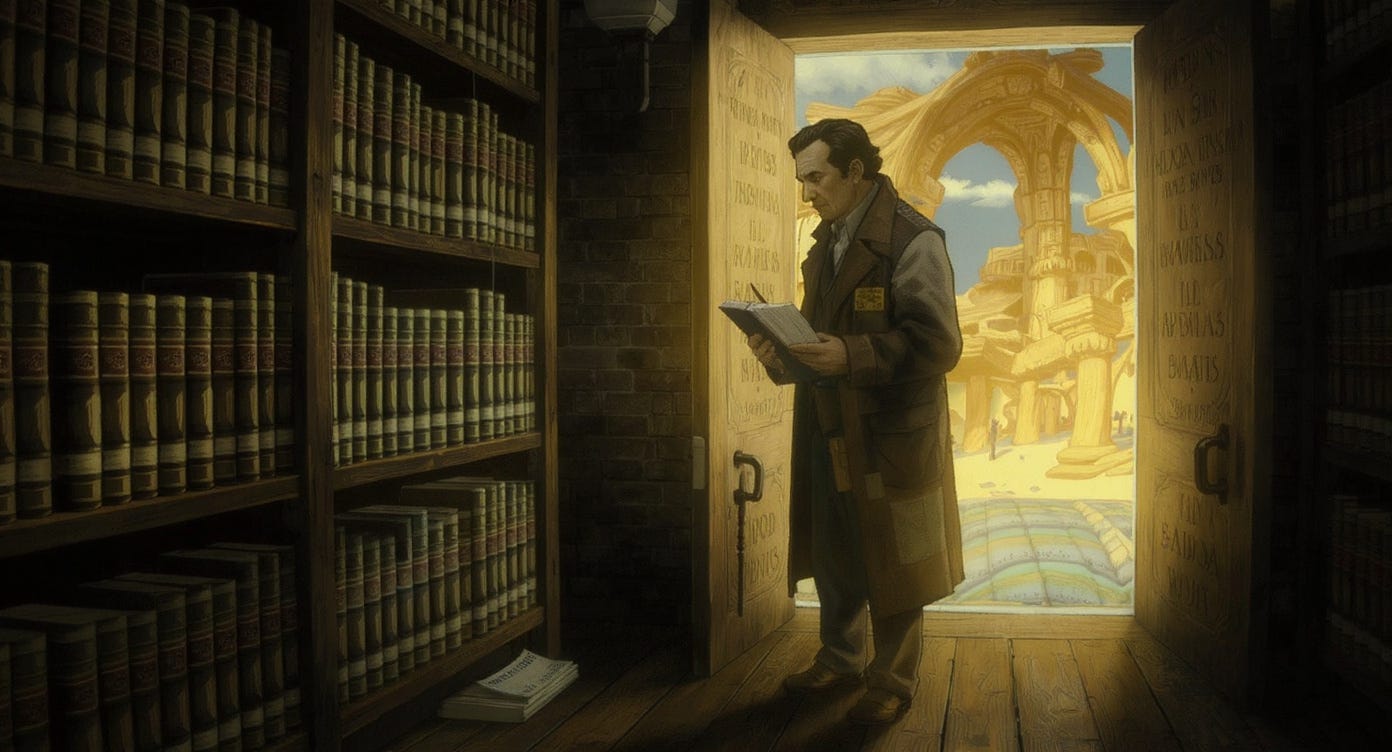
The Library stood at the end of a street that wasn’t always there. Its bricks were the color of old whiskey, and its doors—when they chose to appear—were carved with the names of every god who had ever died.
I found the Librarian shelving books in the Dewey Decimal 999 section, where the catalog numbers bled into one another like wet ink. He wore a coat patched with fragments of forgotten maps, and his eyes were two different colors: one the gray of a storm cloud, the other the gold of a dying sun.
“You’re late,” he said, without turning.
“I didn’t know I had an appointment.”
“You didn’t. But the book did.”
He pulled a volume from the shelf and tossed it to me. The cover was warm, like living flesh, and the title shifted under my fingers: The Gospel of the Last Tuesday → A Manual for Time-Thieves → How to Kill a Forgotten God.
“It’s not the same book twice,” I observed.
“Nothing is,” said the Librarian. “Except the ending. That’s always the same.”
I opened it. The first page read: This is the story of how you die.
The second page was blank.
The third page was on fire.
THE LIBRARIAN OF FORGOTTEN SUNDAYS
The library was always empty on Sundays. Or perhaps it was only empty for me.
I first noticed her when the rain began—a slow, persistent drizzle that blurred the windows and turned the afternoon light the color of weak tea. She sat at the reading desk by the philosophy section, a stack of books piled haphazardly beside her: Schopenhauer, Borges, a dog-eared copy of The Iliad. Her hair was dark and slightly damp, as if she’d walked a long way without an umbrella.
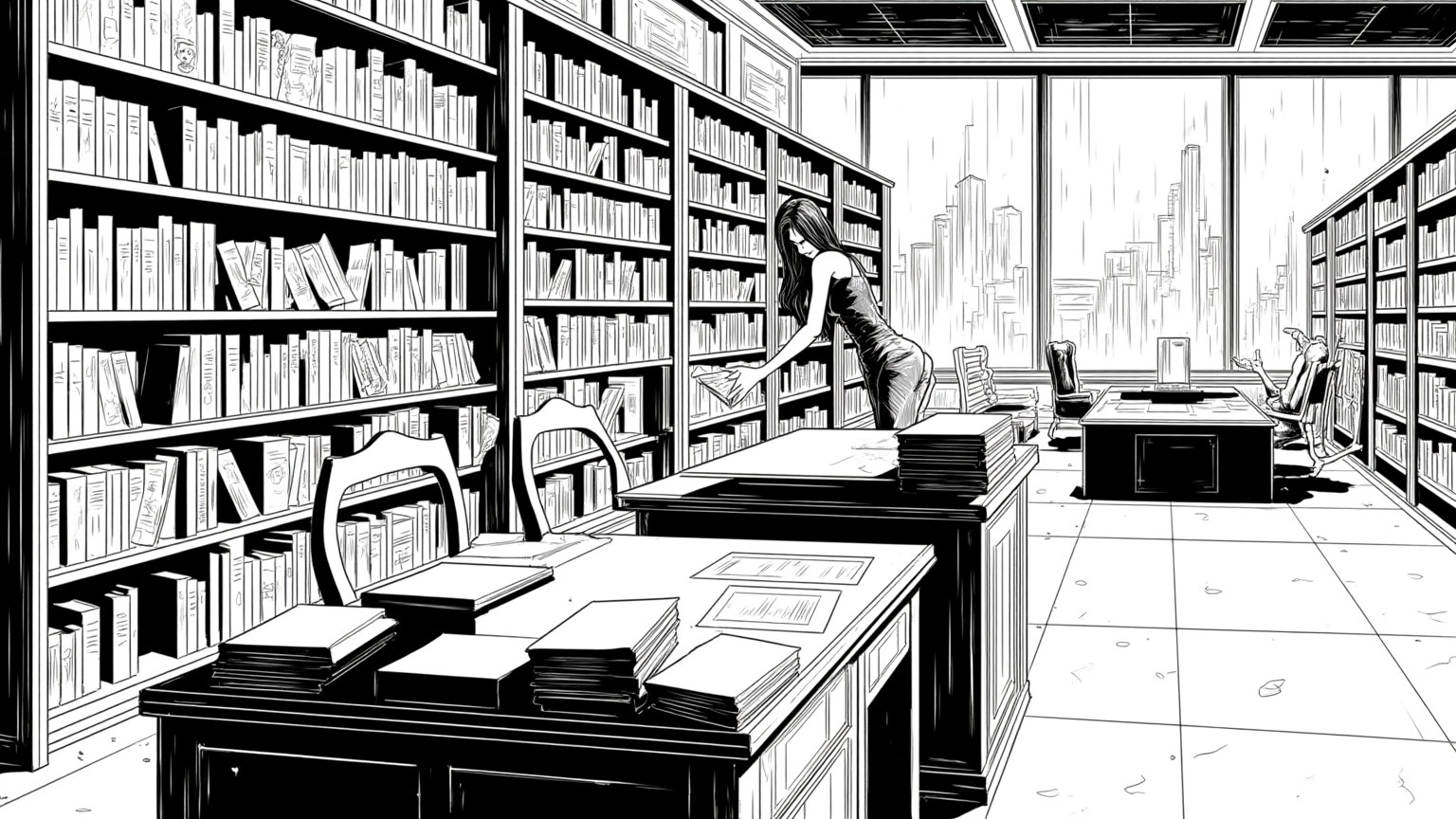
I don’t know why I spoke to her. Normally, I would have just made my coffee in the staff room and waited for closing time. But something about the way she turned the pages—slowly, deliberately, as if deciphering a code—made me ask:
“Do you need help finding anything?”
She looked up. Her eyes were like two wells leading somewhere deep and unseen.
“No,” she said. “I’m waiting for someone.”
“On a Sunday?”
“Especially on a Sunday.”
She pushed a book toward me. The Interpretation of Dreams, in German. Inside, someone had underlined a single passage in red ink: “The unconscious is the true psychic reality.”
“Did you mark this?” I asked.
“No,” she said. “You did.”
And then I remembered. The dream. The staircase leading down into darkness. The sound of a piano playing an old Ray Charles song in reverse.
“I think you’re mistaken,” I said.
She smiled faintly. “Am I?”
Outside, the rain grew heavier. Somewhere in the library, a phone began to ring. No one answered.
THE LIBRARIAN OF FORGOTTEN SUNDAYS
The library was on fire, and it was probably my fault.
Smoke curled around the muzzle of my .45 as I racked the slide. Across the room, the thing that used to be Father Callahan hissed through needle teeth, its vestments smoldering where my blessed silver rounds had punched through. The wound stank of sulfur and rotting parchment.
“You should’ve stayed dead, padre,” I growled.
The demon laughed—a sound like a chainsaw cutting through bone. “This place was dead long before I got here, hunter. Those books? They’re the last prayers of forgotten gods. And she’s the one who collects them.”
A gunshot roared behind me. The demon’s head snapped back, but it kept standing.
“Dammit, Reilly!” Jess shouted, ejecting a spent shell from her sawed-off. “I told you holy water buckshot works better!”
Before I could reply, the ceiling exploded.
Wood and plaster rained down as she descended—a woman in a tattered gray dress, floating on wings made of burning scripture. Her eyes were voids. Her smile was worse.
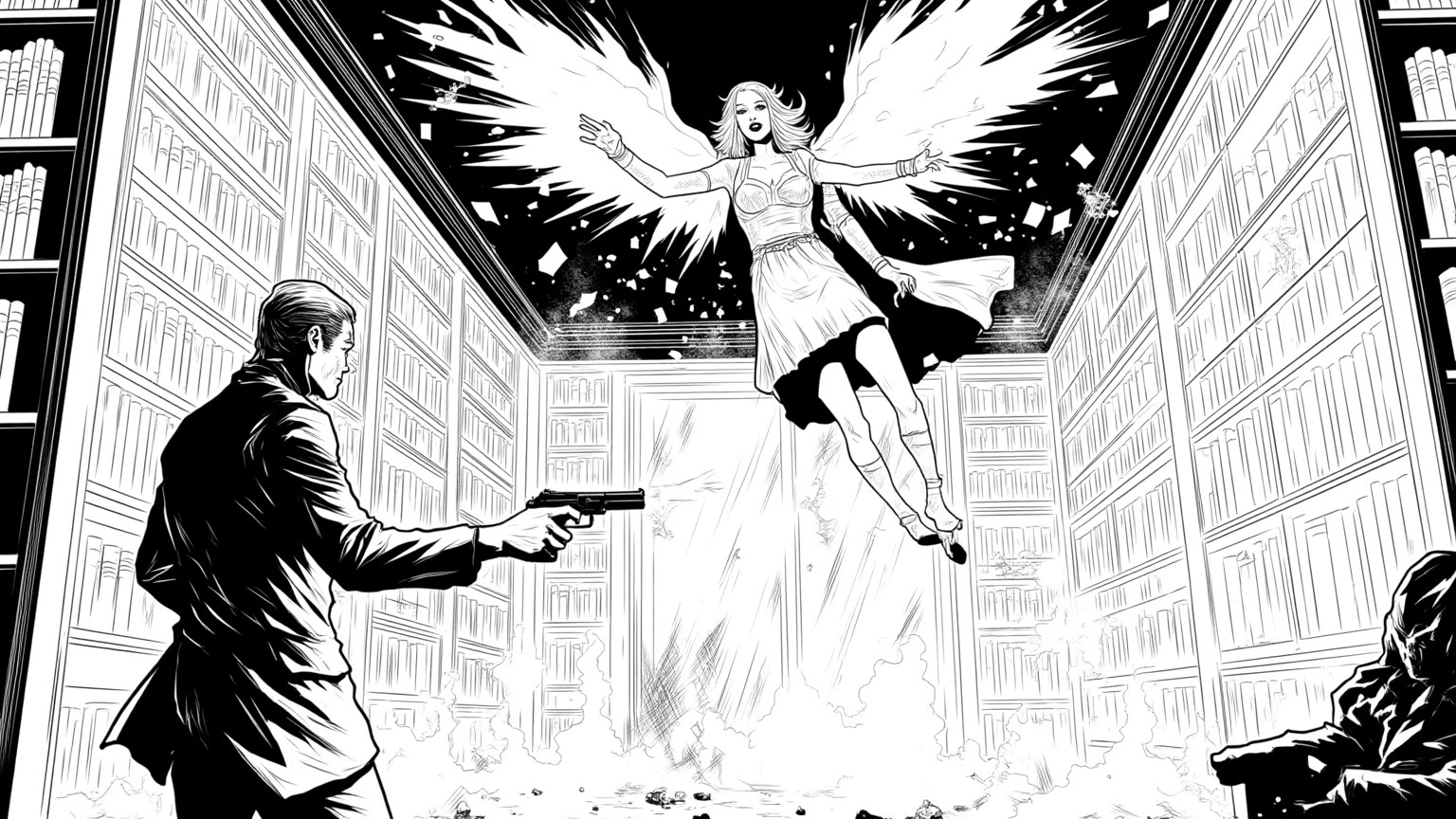
“Ah,” said the Librarian of Forgotten Sundays. “You’ve brought me new books.”
She pointed at us.
The shelves screamed.
THE LIBRARIAN OF FORGOTTEN SUNDAYS
The library was supposed to be closed. But Mike Carroll didn’t give a damn about hours of operation.
He kicked in the side door, the wood splintering under his boot. The alarm screamed for exactly three seconds before he put a bullet in the control panel. Silence. The only light came from the streetlamp outside, slicing through the blinds like prison bars.
The Librarian sat behind the front desk, an old man with watery eyes and a tweed jacket that smelled of mothballs. He didn’t flinch. Just turned a page in his ledger like he’d been expecting company.
“You’re late,” he said.
Carroll leveled the .45 at his forehead. “Where’s the kid?”
“Third floor. Rare manuscripts.” The Librarian licked his thumb, flipped another page. “Though I doubt he’s reading.”
Carroll took the stairs two at a time. The air up here was thick with dust and the sour stink of sweat. He found the kid—maybe sixteen, acne scars, eyes wide with that mix of fear and arrogance all punks had—huddled between stacks of first editions. A Glock trembled in his hands.
“P-please,” the kid stammered. “I didn’t know she was your—”
Carroll shot him twice in the chest. The kid crumpled, knocking over a shelf of Dickens.
Back downstairs, the Librarian hadn’t moved.
“He return the book?” Carroll asked.
The old man slid a leather-bound volume across the desk. “Moby Dick. Overdue. By thirty years.”
Carroll tucked it under his arm. The girl’s name was still scribbled inside the cover in childish cursive. Maria.
He walked out. The door swung shut behind him, the lock clicking like a hammer cocking.
THE LIBRARIAN OF FORGOTTEN SUNDAYS
The library was a labyrinth of whispers. Its shelves stretched farther than the eye could see, vanishing into the gloom of vaulted arches where dust motes danced like heresies awaiting condemnation. The books here were not merely bound in leather and vellum—they were clad in the skins of dead controversies, their spines etched with titles in languages no living tongue could pronounce.
I had come in search of the Codex Umbrarum, a volume rumored to contain every heresy ever conceived but never committed to paper. The Vatican denied its existence. The Illuminati had burned three copies. The librarians of Alexandria had died to protect it. And yet, here I stood, in the Bibliotheca Abscondita, where knowledge went to fester.
The Librarian emerged from the shadows, a gaunt figure in a cassock woven from cobwebs and inkstains. His spectacles were so thick they distorted his eyes into twin pools of black oil.
“You are late,” he said.
“I didn’t know I had an appointment.”
“All who seek the Codex are expected.” He adjusted his glasses, and the light bent unnaturally around them. “Do you know why it is called the Book of Shadows?”
“Because it contains what light cannot reveal?”
“Because,” he said, lifting a skeletal finger, “it is the only book that reads you.”
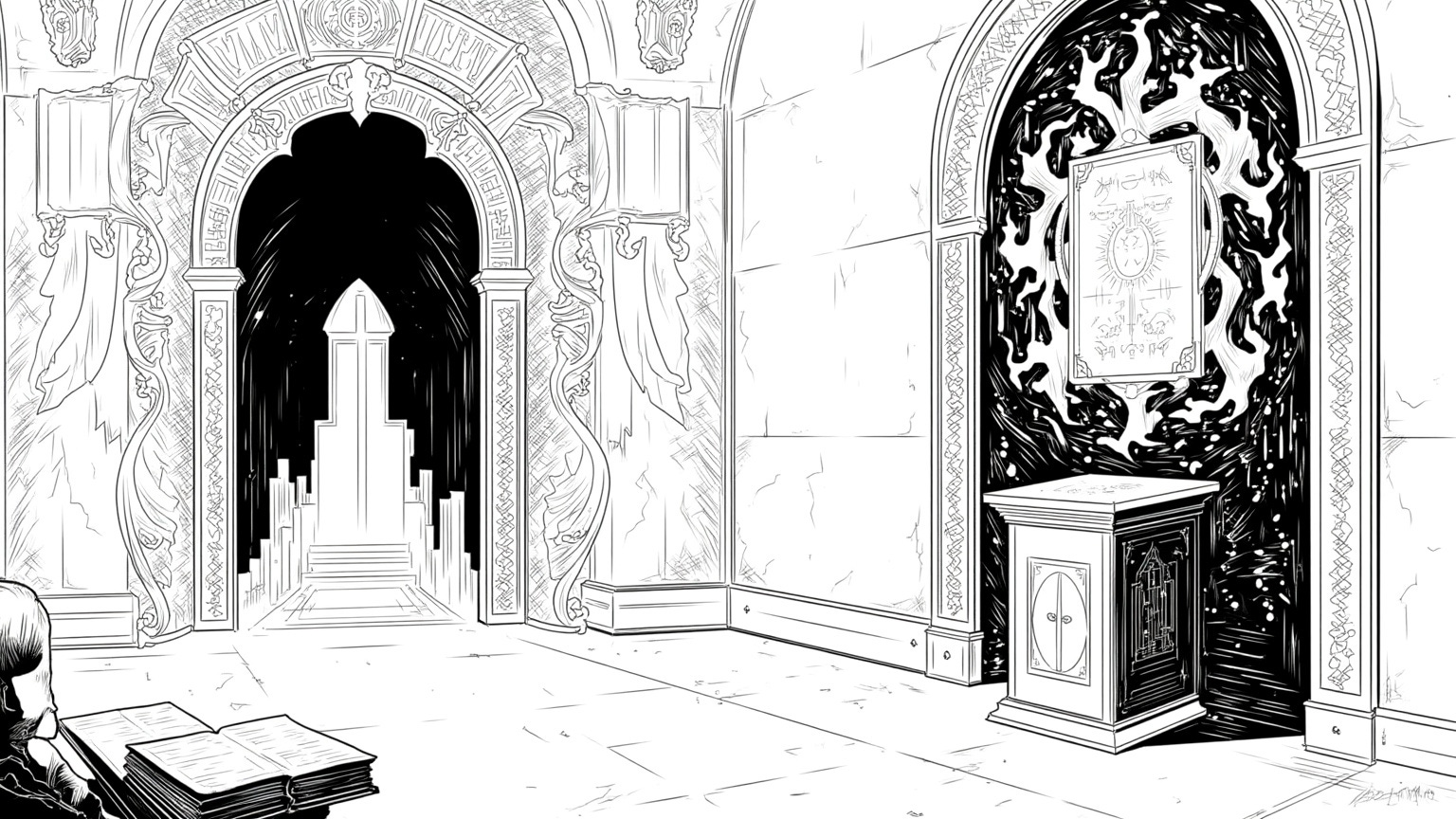
He led me to a iron door engraved with the sigils of suppressed gnostic sects. Behind it lay a chamber where the air tasted of burnt parchment and myrrh. The Codex floated above a pedestal, its pages turning of their own accord.
“The price?” I asked.
“Your certainty,” said the Librarian. “All who consult it leave wiser—but never whole.”
I reached out. The book opened to a page that bore my name.
THE LIBRARIAN OF FORGOTTEN SUNDAYS
The Library of Ash and Ink stood at the crossroads of seven deserts, its walls black as a widow’s nails, its windows glazed with the breath of extinct poets. It was said the Librarian had bound her own shadow into the mortar to keep the building standing.
I found her in the Hall of Unwritten Epilogues, where books sighed on their shelves like jilted lovers. Her hair was the color of rust and ruin, braided with strips of vellum inscribed with the names of the damned. She did not look up as I entered, but her lips—painted with crushed lapis—curved around a silent word.
“You’re late,” she said.
“I didn’t know I was expected.”
“All seekers are expected.” She plucked a book from the air—one that hadn’t been there a moment before—and blew dust from its cover. The title slithered under my gaze: The Gospel of the Last Candle → How to Drown in a Teaspoon of Time → Your Death, Illustrated.
“Choose,” she commanded.
“They’re all the same book.”
“All books are the same book,” she replied. “The difference is in what you’re willing to lose to read them.”
I reached out. The moment my fingers brushed the spine, the library dissolved into a chorus of sobbing voices. The Librarian’s laughter was the sound of pages tearing.
“Ah,” she murmured. “You’ve already lost, then.”
THE LIBRARIAN OF FORGOTTEN SUNDAYS
Monsieur Lefèvre had always believed himself a man of reason. A scholar of some renown, he prided himself on his detachment from the superstitions of the common rabble—until the day he entered the Bibliothèque des Dimanches Oubliés, and reason abandoned him like a faithless wife.
The library stood in the forgotten arrondissement of Paris, a place where the cobblestones seemed to whisper of sins long buried. Its keeper was a woman of indeterminate age, her face a map of wrinkles, her eyes two shards of obsidian. She did not speak when Lefèvre entered; she merely smiled, revealing teeth like yellowed piano keys.
“You seek the forbidden,” she said at last, not a question.
Lefèvre scoffed. “I seek knowledge, madame. Nothing more.”
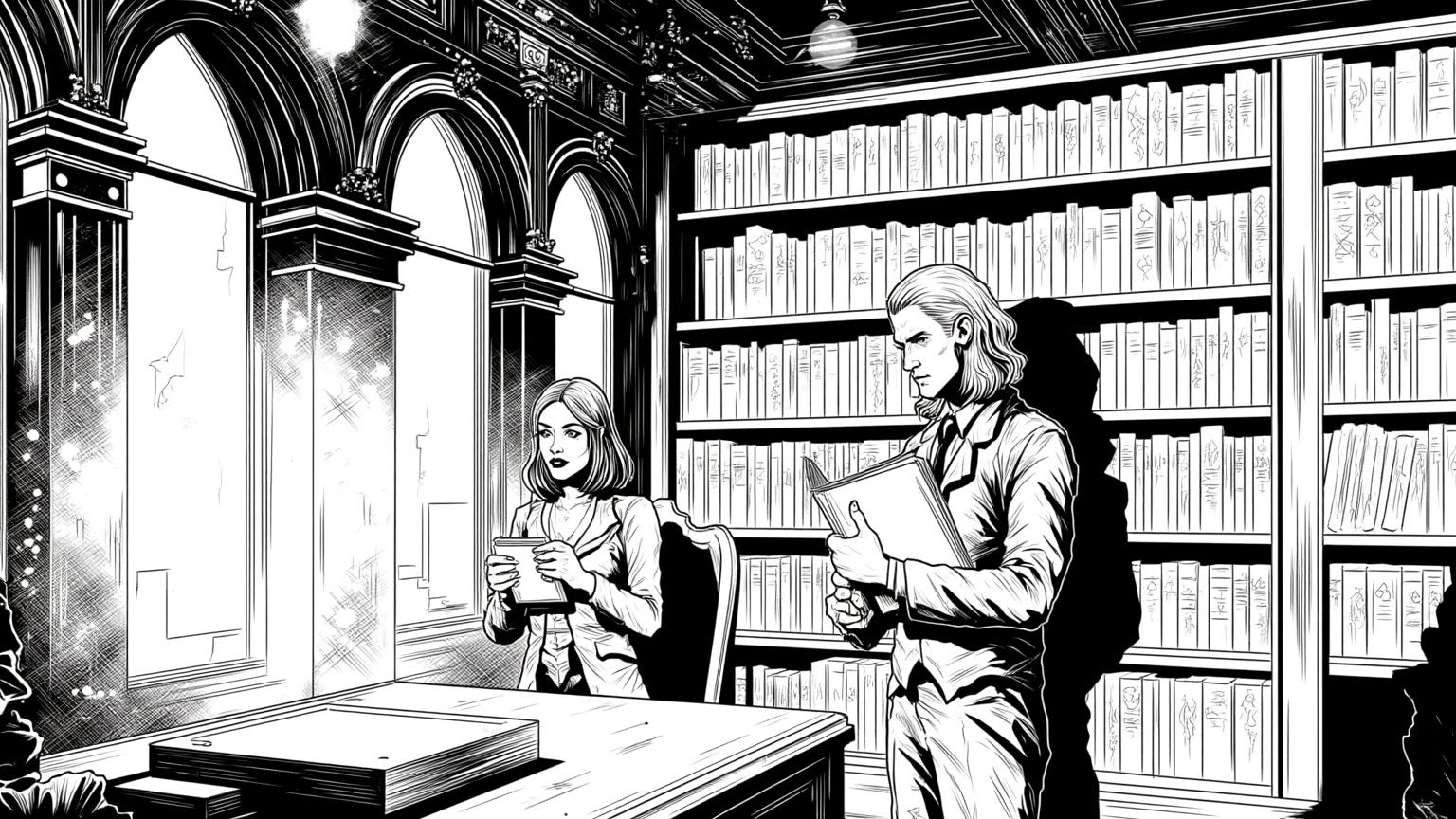
“Ah,” she crooned, stroking the spine of a ledger bound in what appeared to be human skin. “But knowledge is forbidden. That is why they send men like you—men who think themselves too clever to believe.”
He demanded to see the rarest volume in her collection. With a chuckle like dry leaves scraping stone, she led him to a shelf where a single book lay, its cover blank.
“The Librarian of Forgotten Sundays,” she whispered. “A chronicle of all the days God chose to erase.”
When Lefèvre opened it, the pages were empty. Yet as he stared, words began to form—his own name, his secrets, his shames. And then, the laughter started. Not hers.
The library’s.
THE LIBRARIAN OF FORGOTTEN SUNDAYS
The first thing you should know about the Bibliotheca Absurdia is that it doesn’t play by the rules of time, physics, or basic human dignity.
The second thing? It has a very aggressive late-fee policy.
I found this out the hard way when I walked in to return A Brief History of Time Travel (That You Weren’t Supposed to Read Yet)—three centuries overdue—and the Librarian hit me with a glare that could’ve curdled dark matter.
“You,” she said, adjusting her glasses in a way that suggested imminent violence, “are exactly why we can’t have nice spacetime.”
The Librarian of Forgotten Sundays was a tall, no-nonsense woman with a bun tighter than the plot of a Kafka novel and a name tag that just read “MRS. P.” (The “P” stood for something eldritch. I’d asked once. She’d sighed and stamped “DON’T” on my library card in response.)
I slid the book across the counter. “Look, I meant to bring it back, but there was this whole thing with a paradox, and—”
She held up a hand. “Save it for the Temporal Arbitration Board. Your penalty is Section 37-C: Community Service in a Doomed Timeline.”
I groaned. “Not the French Revolution again.”
“Worse,” she said, grinning. “Beta Reading.“
Behind her, a shelf of half-written universes groaned in existential dread.
THE LIBRARIAN OF FORGOTTEN SUNDAYS
The Library of Forgotten Sundays opens only when you're not looking for it. It materializes between a laundromat and a closed bakery, its brass door handles warm to the touch even in winter.
Miriam discovered it on the third anniversary of her father's death, while wandering to avoid the empty apartment where grief still hung like curtains. The library's wooden sign creaked overhead, letters carved deep enough to hold shadows.
"We close at sunset," said the librarian, a woman whose age seemed to shift depending on which angle you observed her from. "And we don't lend books. They must remain here."
The shelves stretched impossibly upward, books arranged not alphabetically but by the quality of light that had filtered through stained glass windows on the Sundays they contained.
"What am I looking for?" Miriam asked.
The librarian smiled. "Most people find the Sunday they've lost."
Miriam wandered between mahogany shelves until she found a slim volume bound in familiar blue—the color of the sweater her father wore on their last Sunday together. When she opened it, the scent of his pipe tobacco and the sound of his laughter filled the space between pages.
Inside, she read not words but moments: pancake breakfasts, newspaper rustlings, his hand steady on her shoulder.
When sunset came, Miriam closed the book.
"Can I come back?" she asked the librarian.
"The library finds those who need it," the woman replied. "But the Sundays you keep after leaving—those are yours to remember."
THE LIBRARIAN OF FORGOTTEN SUNDAYS
J. received the summons on a Thursday, though he was certain he had never applied for library privileges. The document, stamped with an illegible seal, stated only that his presence was required "for the matter of accumulated Sundays."
The building itself seemed to shift location each time J. approached it. When he finally entered, a clerk with wire spectacles examined his papers for an unconscionable length of time.
"You are here about the Sundays," the clerk said. It was not a question.
"I don't understand what Sundays you mean," J. replied.
"The ones you failed to observe properly. They accumulate, you see. Form a debt."
J. was led through corridors lined with filing cabinets, each drawer labeled with dates that seemed to stretch infinitely into the past. The air smelled of bureaucracy and neglect.
"But I observe every Sunday," J. protested.
The clerk stopped abruptly. "Observe? Or merely endure? There is a significant administrative difference."
They arrived at a vast reading room where dozens of pale individuals sat hunched over empty desks, writing furiously in blank ledgers. A sign above read: "Sunday Reclamation Department - Remedial Division."
"You will reconstruct each Sunday you have wasted," the clerk explained, "in triplicate. Only then can your file be closed."
J. took his assigned seat. The pen felt impossibly heavy in his hand. Outside, it was always Sunday now, but somehow that made it worse.
He began to write.
Three is definitely Jim Butcher. Very similar opening to Dresden Files #6 "Blood Rites," "The building was on fire, and it wasn't my fault."