

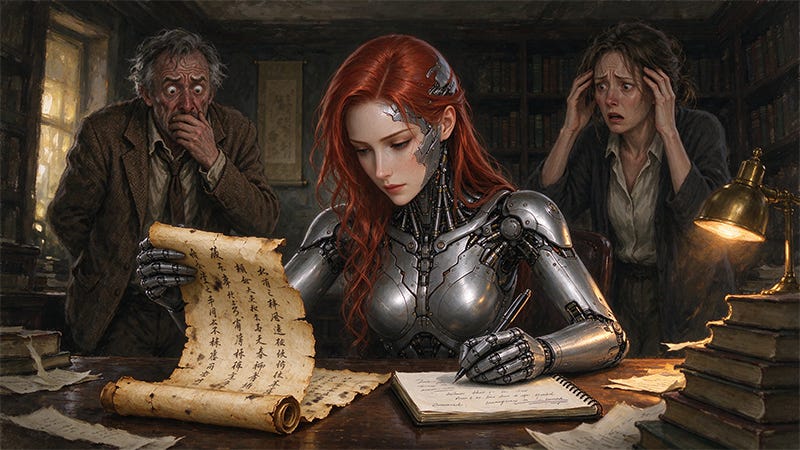
Publishers Weekly reports that translators have now joined the Authors Guild’s futile anti-AI lawsuit.
The American Literary Translators Association (ALTA) has joined a coalition of 11 other organizations representing writers, journalists, photographers, and other creative professionals in supporting authors suing OpenAI and Microsoft, arguing that the companies’ use of copyrighted works to develop AI tools threatens their livelihoods.
In an October 30 brief filed in the high-profile copyright case brought by the Authors Guild and other authors, ALTA argues that the potential economic harm from generative AI extends beyond book authors to other creative professionals, including literary translators.
The brief was co-signed by 11 other professional organizations, including the American Society of Journalists and Authors, the National Writers Union, Romance Writers of America, and the Dramatists Guild of America.
ALTA argues that widespread adoption of AI translation tools could turn translators “from interpreters into primarily editors of large language model outputs,” the brief states, echoing a concern PW reported on in September. The organization also said literary translations are original works protected by copyright, even though they are based on and licensed from another author’s work. Translators make their own creative decisions in carrying an author’s words, voice, and style into another language, ALTA argues, and should be recognized as authors in their own right.
It’s really remarkable to see the way the white-collar class is desperate to save their jobs in a way they never exhibited when blue-collar jobs were being exported to foreign countries and replaced by technological innovations and immigrants.
It’s darkly amusing that they imagine anyone is going to care about them losing their jobs anymore than they cared about all the autoworkers, and steelworkers, and textile workers, and millworkers losing their jobs beginning in the 1980s.
It’s just the price of progress, right? It’s just creative destruction operating for the benefit of us all, right?
The thing is, they don’t have a legal leg to stand on. Providing a text to an AI to train itself is no different than reading a book in order to learn something from it. They’re literally arguing against their own purpose and profession, by attempting to outlaw anyone looking at a text depending upon what their reason for doing so happens to be.
But they are right to fear for their profession, because except for the very, very best professional translators, by which I mean those at the William Weaver level of accomplishment, human-only translation is not only no longer necessary, it’s not even desirable.
Castalia House has completed more than 150 translations from various languages and conducted several blind “taste tests” comparing up to six different translations. In every single case, in languages ranging from German to Japanese, the human-directed AI translation proved superior to nearly all of the human-only translations.
Furthermore, most of the translations Castalia House has done had never been translated before. When human translators can’t bother to translate excellent works that have been published for more than a century, and in some cases, have been in the public domain for more than a century, they really don’t serve much of an important purpose in the first place.
For example, neither the 46 volumes of the Episodios Nacionales of Benito Perez Galdos nor the 24 volumes of The Epic Tale of the Heike by Eiji Yoshikawa had ever had more than a small fraction of the complete work translated into English. Now, thanks to AI, excellent translations of all 60 volumes of both works are available on Castalia Unlimited for its subscribers.
Ten of the 24 volumes of The Epic Tale of the Heike available for download.

Ten of the 25 volumes of the Episodios Nacionales available for download.

If you want to enjoy the full power of what AI translation is now making possible, subscribe to Castalia Unlimited and enjoy the very best of world literature.