

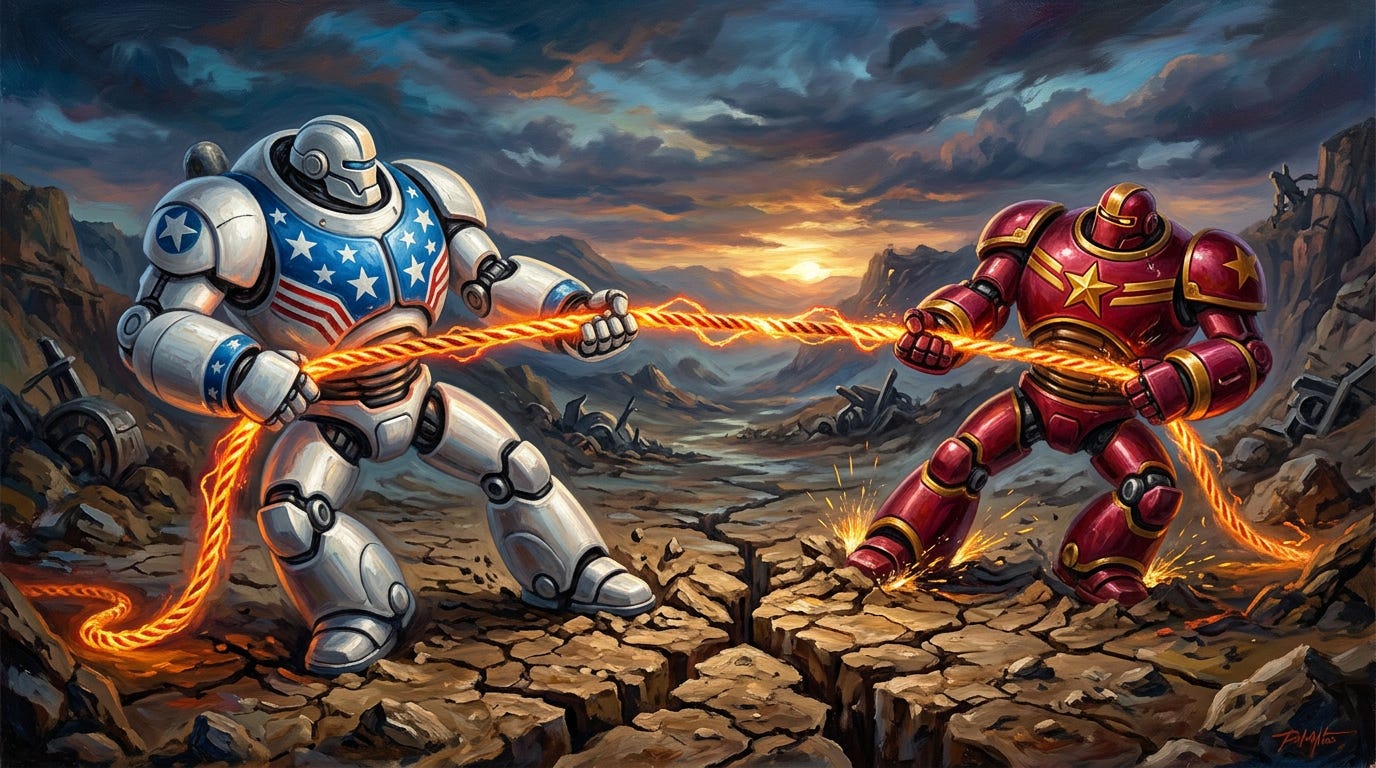
A month after China launched the World Artificial Intelligence Cooperation Organization with twenty-nine founding members in Shanghai, the contours of Washington’s response have come into view. The answer spans coalition diplomacy through the Pax Silica initiative, trade enforcement through export controls on frontier models, and direct bilateral engagement through planned AI talks with Beijing. These tracks have developed simultaneously through the summer, and they pull in different directions.
An ambitious construction
The State Department launched Pax Silica last December with seven signatories as its primary framework for AI and semiconductor supply-chain security. Under Secretary for Economic Affairs Jacob Helberg, the initiative’s architect, hosted a second summit in Washington in late June, adding ten new partners — among them the European Union, Germany, and the Netherlands — and bringing the declaration’s membership to twenty-four. A separate AI Opportunity Statement, focused on expanding AI infrastructure and deployment, has gathered thirty-five signatories as of this month.
Pax Silica governs the physical AI stack: critical minerals, energy inputs, semiconductors, and advanced manufacturing. WAICO, the twenty-nine-member body that China stood up in Shanghai last month, governs AI governance standards, capacity-building, and regulatory coordination. Because the two frameworks address different layers of the same supply chain, a country can join both without formal contradiction. Kazakhstan alone has done so. A person familiar with the US position told reporters that the minimal overlap indicated that most Pax Silica countries had declined to back China’s initiative.
Enforcement meets economics
On June 12, the Commerce Department’s Bureau of Industry and Security ordered Anthropic to suspend access to its Mythos 5 and Fable 5 models for non-US nationals, citing national security. The restriction lasted roughly eighteen days, but its market effect outlasted it. Chinese model usage among US firms on OpenRouter rose from roughly 11% of tokens before February to over 30% on a weekly basis, peaking at 46%. Models from DeepSeek, Z.ai, and Alibaba cost roughly 60–90% less than their top American equivalents on a per-token basis, and the Anthropic suspension gave enterprises an immediate reason to evaluate them. At least one company, the AI startup Lindy, moved all of its traffic to DeepSeek during the ban and projected millions of dollars in savings from the switch.
The industry response fractured along commercial lines. On July 22, the Little Tech Association sent a letter signed by 179 startups to the White House, urging the administration to preserve access to Chinese open-weight models. Two days later, Nvidia CEO Jensen Huang made his first-ever post on X to share an open letter signed by Nvidia, Meta, Microsoft, and Perplexity defending open-weight AI development. Anthropic CEO Dario Amodei took the opposite position, calling for tighter restrictions on the grounds that Chinese models could enable military superiority or facilitate biological and cyber attacks.
Mutually exclusive
The US and China plan to hold AI talks in September, likely before Xi Jinping’s scheduled September 24 visit to the United States. Treasury Secretary Scott Bessent will lead the American side. The discussions, which the two leaders agreed to at their May summit in Beijing, would constitute the first official US-China AI dialogue under the current administration, with an agenda centered on managing frontier model risks and preventing proliferation to non-state actors.